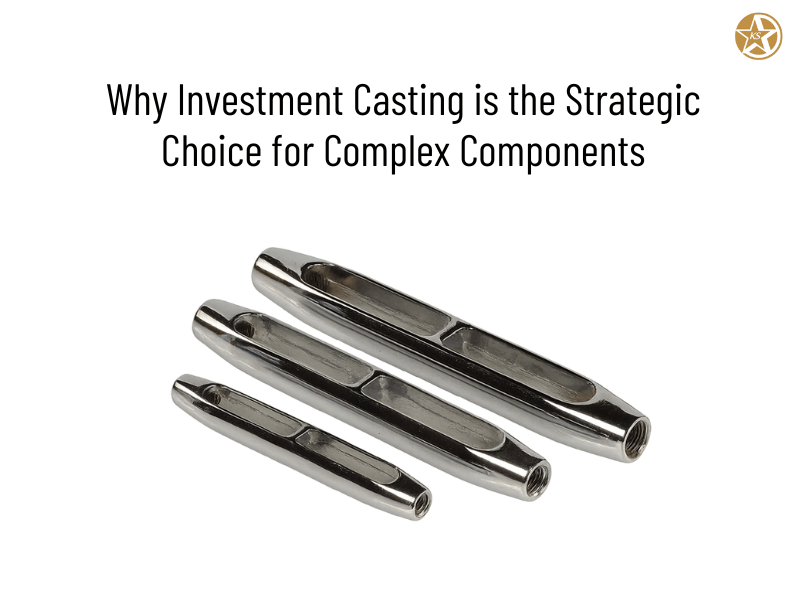
Complex metal components often create a difficult manufacturing decision. CNC machining may remove too much material, sand casting may not provide the required detail, and die casting may require a production volume that does not match the project.
Investment casting, also known as lost wax casting, can provide another option. It is particularly valuable when a component combines complex geometry, dimensional requirements, difficult-to-machine features, and the need to control secondary processing.
However, investment casting is not automatically the best process for every complex part. Its suitability depends on geometry, material, tolerances, production quantity, tooling investment, inspection requirements, and total manufacturing cost.
Table of Contents
- When Should You Choose Investment Casting?
- Investment Casting Selection at a Glance
- What Is Investment Casting?
- Four Situations Where Investment Casting Creates Real Value
- Investment Casting vs. Other Manufacturing Processes
- How Investment Casting Can Reduce Total Production Cost
- What Tolerances Can Investment Casting Achieve?
- The Investment Casting Process at King Shine
- What Should Buyers Provide?
- Is Investment Casting Right for Your Component?
Quick Answer: When Should You Choose Investment Casting?
Investment casting is worth evaluating when the component requires:
- Complex external or internal geometry
- Curved surfaces or detailed features
- Reduced parting-line and draft-angle restrictions
- Better surface finish than conventional sand casting
- Near-net-shape production
- Less material removal than machining from solid stock
- Consolidation of several pieces into one casting
- Repeatable production of difficult-to-machine components
It may not be the best choice when:
- The geometry is simple and easy to machine
- The component is very large or heavy
- Extremely tight features still require complete CNC machining
- The order quantity cannot justify tooling costs
- Sand casting can already meet the dimensional and surface requirements
- The production volume and alloy are more suitable for die casting
Investment Casting Selection at a Glance
| Project Condition | Investment Casting May Be Suitable When… | Another Process May Be Better When… |
|---|---|---|
| Geometry | The part contains curves, detailed surfaces, irregular shapes, or difficult-to-machine features. | The part has a simple profile or can be efficiently machined. |
| Tolerance | The casting must reduce secondary machining while maintaining repeatable dimensions. | Every critical surface requires very tight machining tolerance. |
| Surface finish | A smoother as-cast surface is required. | Surface appearance is not important. |
| Part consolidation | Several welded or assembled pieces can potentially become one casting. | Separate parts are easier to manufacture, replace, or maintain. |
| Production quantity | Repeat production can justify tooling development. | Only one or very few simple parts are required. |
| Component size | The part is within a practical size and weight range for the process. | The component is particularly large, thick, or better suited to sand casting. |
| Total cost | Near-net-shape production can reduce machining, assembly, and material waste. | Tooling costs outweigh the expected production savings. |
What Is Investment Casting?
Investment casting uses a wax pattern to produce a ceramic mold.
The wax patterns are assembled, coated with multiple layers of ceramic material, and then removed from the hardened shell. Molten metal is poured into the resulting cavity. After solidification, the ceramic shell is removed and the castings are separated, finished, inspected, and machined where necessary.
Because the ceramic mold follows the shape of the wax pattern, the process can reproduce details and geometries that may be difficult to achieve through conventional casting methods.
Investment casting should still be regarded as a manufacturing process with design rules and practical limitations. Wall thickness, transitions, internal passages, radii, shrinkage, metal flow, and tooling design all affect the final result.
Four Situations Where Investment Casting Creates Real Value
1. A Complex Part Requires Extensive CNC Machining
Machining a complex component from solid stock can require several setups, long cycle times, special fixtures, and considerable material removal.
Investment casting can produce a shape closer to the final geometry. CNC machining can then be reserved for critical features such as:
- Sealing surfaces
- Mounting faces
- Precision bores
- Threads
- Bearing seats
- Critical mating dimensions
This does not mean investment casting eliminates machining. The advantage is that it may reduce how much machining is required.
2. Several Components Could Be Consolidated into One Casting
Some products are originally manufactured from several pieces that must be welded, fastened, or assembled.
If the geometry and service requirements allow, investment casting may combine these pieces into one component. Potential benefits include:
- Fewer assembly operations
- Fewer fasteners or welds
- Fewer potential leakage or failure points
- More consistent alignment
- Simplified inventory management
Part consolidation must be reviewed carefully. A one-piece design is not always better if individual sections need to be replaced or maintained separately.
3. The Part Contains Detailed or Irregular Features
Investment casting can be considered for components containing:
- Curved profiles
- Logos or identification marks
- Serrations
- Ribs
- Bosses
- Irregular external surfaces
- Features positioned at different angles
Unlike traditional sand casting, the process can reduce some restrictions associated with parting lines and draft angles. However, wax tooling, shell building, metal flow, and mold removal requirements must still be considered during design.
4. Surface Quality and Appearance Matter
A smoother as-cast surface can reduce grinding, polishing, and cosmetic finishing requirements.
This can be useful for visible hardware, valve components, machinery hardware, marine hardware, and parts where surface consistency affects subsequent finishing.
The required surface condition should be specified clearly. Functional sealing or bearing surfaces may still require machining even when the overall casting surface is acceptable.
Investment Casting vs. Other Manufacturing Processes
| Process | Best Suited For | Main Advantage | Possible Limitation |
|---|---|---|---|
| Investment casting | Complex, detailed, near-net-shape metal components | Design flexibility, surface quality, and reduced machining potential | Requires tooling and a multi-stage production process |
| Sand casting | Larger or simpler cast components | Flexible size range and relatively economical tooling | Rougher surface and wider dimensional variation |
| CNC machining | Low-volume parts and highly controlled critical features | High dimensional control without casting tooling | High material waste or long cycle time for complex shapes |
| Die casting | High-volume production of suitable non-ferrous alloys | Fast production cycles and repeatability | Higher tooling investment and alloy limitations |
| Centrifugal casting | Cylindrical parts such as bushings, sleeves, rings, and liners | Dense structure in rotationally symmetrical components | Not intended for unrestricted complex geometry |
The correct comparison should be based on the total manufacturing route. For example, an investment-cast part may still require CNC machining, heat treatment, surface treatment, leak testing, or dimensional inspection.
How Investment Casting Can Reduce Total Production Cost
Investment casting is not necessarily the lowest-cost process at the tooling stage. Its economic value usually appears when the entire production process is considered.
Potential savings may come from:
- Lower raw-material removal
- Fewer machining operations
- Reduced fixture requirements
- Part consolidation
- Less welding or assembly
- More consistent repeat production
- Reduced finishing work
For example, machining a highly irregular component from a solid block may appear convenient for a prototype. As production quantity increases, however, material waste and machine time can become significant.
Investment casting may provide a lower total unit cost once the tooling investment is distributed across repeat orders. The break-even point depends on the alloy, geometry, machining time, tooling complexity, rejection risk, and order quantity.
What Tolerances Can Investment Casting Achieve?
Investment casting generally provides better dimensional consistency than conventional sand casting, but not every dimension can be held to the same tolerance.
Tolerance capability is affected by:
- Overall part size
- Feature location
- Wall thickness
- Part geometry
- Alloy shrinkage
- Wax-pattern stability
- Shell-building conditions
- Straightness and roundness requirements
King Shine provides a dedicated reference for its general precision investment casting tolerances. Critical dimensions should still be identified on the drawing and reviewed before tooling begins.
Dimensions that affect sealing, rotation, bearing fits, or assembly may require machining even when the remaining geometry is left as cast.
The Investment Casting Process at King Shine
A typical project may include the following stages:
- Drawing and feasibility review
The part geometry, material, tolerances, machining areas, quantity, and inspection requirements are evaluated. - Tooling and wax injection
Tooling is produced to create repeatable wax patterns. - Wax-pattern assembly
Multiple patterns may be attached to a central runner system. - Ceramic shell building
The wax assembly is repeatedly coated to form a heat-resistant ceramic shell. - Dewaxing and shell preparation
The wax is removed, leaving a cavity for molten metal. - Melting and casting
The selected alloy is melted and poured according to the casting plan. - Shell removal and finishing
Castings are separated, cleaned, blasted, and finished as required. - Machining and inspection
Critical features are machined and verified according to the drawing. - Testing and delivery
Depending on the project, dimensional inspection, visual inspection, air-pressure testing, or water-pressure testing may be performed.
More information is available on King Shine’s lost wax casting service page.
What Should Buyers Provide for a Casting Evaluation?
To determine whether investment casting is the right process, buyers should provide:
- 2D drawings and 3D files
- Required alloy or operating conditions
- Annual and per-order quantities
- Critical dimensions and tolerances
- Surface-finish requirements
- Machining areas
- Heat-treatment or coating requirements
- Leak-testing or inspection requirements
- Current manufacturing problems
- Target application and service environment
If the material has not been finalized, information about load, corrosion, temperature, wear, and compliance requirements can help evaluate suitable alloy options.
Is Investment Casting the Right Choice for Your Component?
Investment casting is a strategic choice when complex geometry, surface quality, repeatability, part consolidation, and reduced machining can create measurable production value.
It should not be selected simply because a component looks complicated. A complete evaluation must consider whether the process can improve the total manufacturing route compared with sand casting, centrifugal casting, die casting, or CNC machining.
King Shine Resource Co., Ltd. can review your drawings, material requirements, critical dimensions, machining scope, inspection needs, and estimated production quantity. This allows the casting process and subsequent operations to be planned together rather than evaluated separately.
Need Help Evaluating a Complex Component?
Have a complex metal component that is expensive to machine or difficult to produce consistently?
Share your drawing, material requirements, target quantity, and application conditions with King Shine. Our team can help evaluate whether investment casting is suitable and recommend an appropriate casting, machining, and inspection plan.
Contact Us