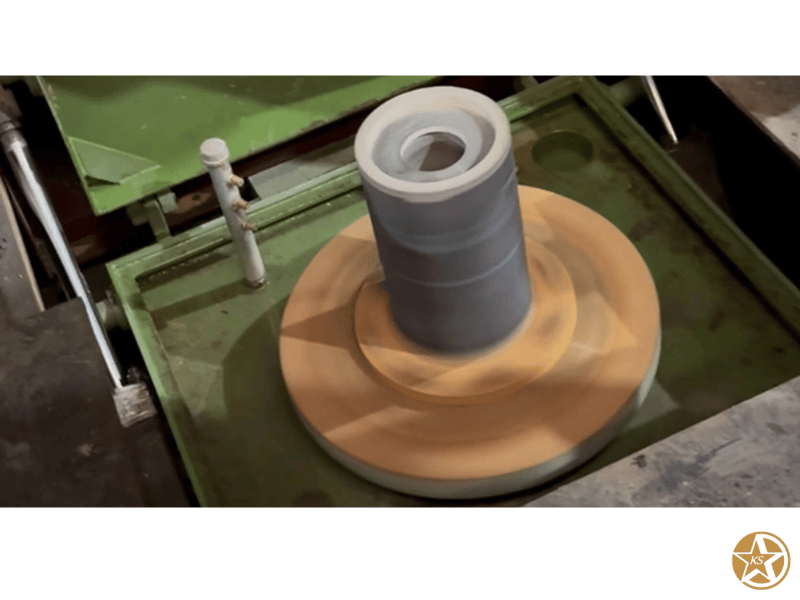
Centrifugal casting is a metal casting process that uses rotational force to form parts—especially cylindrical and hollow components. Instead of relying only on gravity to fill a mold, the process spins the mold at a controlled speed so molten metal is forced outward against the mold wall. This is why centrifugal casting is widely used for parts like bushings, sleeves, rings, liners, and valve seats, where material density, structural integrity, and wear life matter.
At King Shine Resource Co., Ltd., centrifugal casting is one of the key processes we use when customers need consistent wall quality and reliable performance for copper alloys, stainless steel, and other materials—especially when they are evaluating a copper casting manufacturer for long-term sourcing.
What Is Centrifugal Casting?
Centrifugal casting is a method where molten metal is poured into a rotating mold. As the mold spins, centrifugal force pushes the metal to the outer diameter (OD), creating a dense working wall. Solidification typically happens from the outside inward, which supports uniform structure and reduces shrinkage-related defects in the critical wall area.
A practical way to understand it: centrifugal casting “packs” the metal against the mold surface. In many cases, any inclusions or lighter impurities tend to concentrate closer to the inner surface (ID), which can later be removed during machining—helping you achieve a sound final component.
The Basic Centrifugal Casting Process
While the exact parameters depend on alloy and size, the process generally follows these stages:
- Mold Preparation: The mold is installed on a rotating machine. It may be preheated, coated, and checked for alignment and stability.
- Melting & Metal Preparation: The alloy is melted to the required temperature; melt cleanliness control reduces porosity and inclusions.
- Pouring into a Rotating Mold: Molten metal is introduced while the mold is spinning at a controlled speed.
- Solidification Under Rotation: The outer wall becomes dense; cooling rate and rotation influence grain structure and properties.
- Rough Casting Treatment: The casting is removed and cleaned; bore surfaces may be prepared for finishing.
- Machining and Inspection (as required): ID/OD, faces, and sealing surfaces are machined; inspection confirms dimensions and integrity.
- Final Inspection, Packaging, and Shipping: Final checks and documentation are completed before delivery.
Main Types of Centrifugal Casting
- True Centrifugal Casting: Used for hollow parts like tubes, sleeves, and rings. The ID is formed naturally without a core—common for industrial bushings and liners.
- Semi-Centrifugal Casting: Used for rotationally symmetric parts that may be more solid in shape. Rotation improves feeding and reduces shrinkage defects.
- Centrifuge Casting: Multiple small molds are filled from a rotating system—useful for smaller castings where rotation assists filling and quality.
Why Choose Centrifugal Casting? Key Advantages
- Higher density, lower porosity: The working wall is typically more compact, improving strength and wear resistance.
- Excellent for hollow shapes: Many hollow components can be produced without complex cores.
- Better structural uniformity: Controlled rotation helps achieve consistent properties along the casting length.
- Efficient use of material: Near-net hollow formation can reduce waste versus machining from solid bar stock.
- Machining-friendly quality strategy: Inner-surface inclusions (if present) can be removed during finishing.
Centrifugal casting delivers the best value when the part geometry matches the process: rotational symmetry, predictable wall thickness, and acceptability of finish machining.
Common Materials for Centrifugal Casting
Material selection should be driven by corrosion environment, wear, temperature, and machinability needs:
- Brass: Cost-effective, easy to machine, common for fittings and certain valve-related components.
- Bronze (including Aluminum Bronze): Strong wear resistance and corrosion performance—popular for marine and heavy-duty bushings.
- Stainless Steel: High corrosion and temperature resistance for harsh media or pressure applications.
- Aluminum Alloys: Lightweight and easy to machine; useful when reduced inertia or thermal conductivity matters.
For buyers sourcing copper-based alloys, centrifugal casting is often a practical pathway because it produces dense working walls and predictable machinable stock—one reason procurement teams may shortlist a copper casting manufacturer that can support both casting and machining under one quality system.
Typical Applications
- Bearings, bushings, and sleeves for rotating/sliding assemblies
- Rings and liners in wear or sealing locations
- Valve seats and cylindrical valve components
- Marine and pump components requiring corrosion + wear resistance
Design Considerations (DFM)
- Machining allowance: Plan enough stock for ID/OD cleanup and tolerance achievement.
- Wall thickness strategy: Avoid extreme thin-to-thick transitions; aim for consistent sections where possible.
- Length-to-diameter ratio: Impacts straightness and stability during rotation.
- Surface requirements: Bearing/sealing surfaces typically need machining and finish verification.
- Tolerance planning: Define which dimensions are as-cast vs. final machined early to reduce redesign loops.
Inspection & Quality Control
- Dimensional inspection: ID/OD, wall thickness, straightness, concentricity, and face runout after machining.
- Visual inspection: Surface condition and defect checks.
- NDT (as required): UT for wall integrity, RT for critical parts, PT for surface crack detection.
- Documentation: Material verification and inspection reports for traceability.
Centrifugal Casting vs. Other Casting Methods
Centrifugal casting is not a replacement for sand or investment casting—it is a specialized solution. It is usually the best choice when the part is rotationally symmetric, you need dense walls, and finish machining is acceptable to reach final tolerances. If your part has complex external geometry or fine detail features, sand casting or investment casting may be a better match.
Conclusion
Centrifugal casting is a reliable, industrial-grade method that uses rotation to create dense, defect-resistant metal structures. For cylindrical and hollow parts—such as bushings, sleeves, rings, and valve seats—it offers a strong balance of performance, consistency, and manufacturing efficiency. With the right material selection, machining strategy, and inspection plan, centrifugal casting can significantly improve durability and reduce defect risk in critical applications.
If you are comparing suppliers and need a partner who can support alloy selection, machining, and inspection planning, King Shine Resource Co., Ltd. can assist—especially for copper alloy projects where choosing the right copper casting manufacturer directly affects long-term quality and reliability.
Learn more:
Centrifugal vs. Sand vs. Investment Casting: Which Method Fits Your Project?