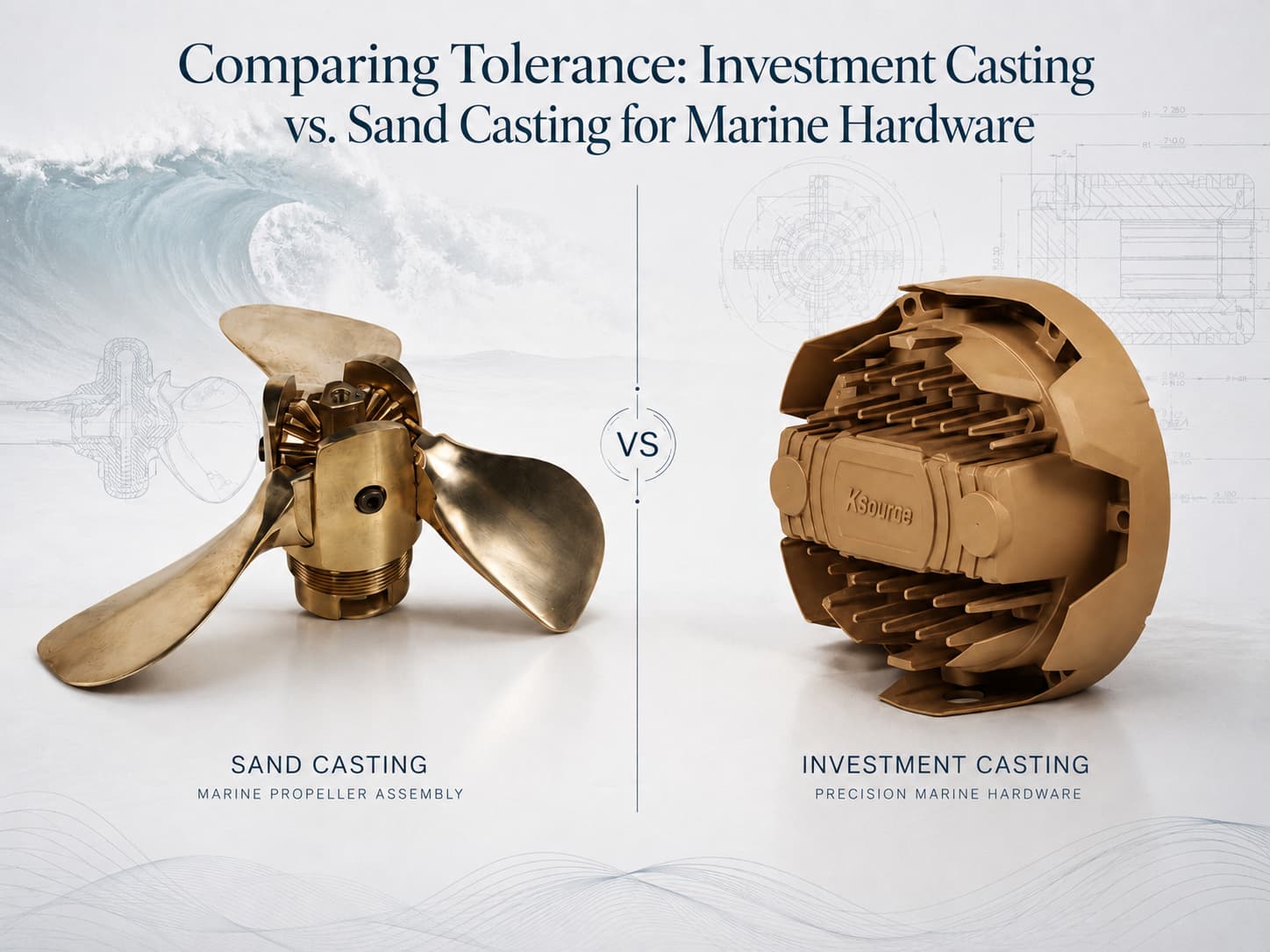
Marine hardware operates under salt spray, vibration, and long-term load cycles. In this environment, tolerance is not a cosmetic detail—it affects assembly fit, sealing performance, interchangeability across lots, and overall reliability.
At King Shine Resource Co., Ltd., we support marine hardware programs using multiple casting routes, including Investment Casting (Lost Wax Casting) and Sand Casting. Both processes can produce robust marine components, but they differ in as-cast dimensional behavior, machining dependence, and the right way to specify tolerances. This article compares the two through an engineering and sourcing lens.
What “Tolerance” Really Means in Marine Hardware
Marine tolerance is usually a system requirement, not a single dimension
When buyers ask for “tight tolerance,” they often mean:
- Assembly fit: holes align, hinges swing smoothly, handles sit flat
- Leak/seal performance: flatness and surface finish drive sealing reliability
- Interchangeability: parts from different batches fit the same mating components
- Functional alignment: concentricity/runout matters for rotating parts and valve interfaces
- Visual consistency after finishing: polishing/plating shouldn’t break edges or expose mismatch
In marine hardware, tolerance is tied to how the part functions in an assembly and how consistently a supplier can hold the critical-to-function features over time.
Separate tolerances into three zones on your drawing
To avoid paying for unnecessary machining (or getting inconsistent assembly), separate requirements into:
A. As-cast cosmetic zone
- Non-mating surfaces, external contours that will be polished or coated
- Goal: stable appearance and defect control (no pits, misruns, or sand inclusion showing through finishing)
B. Machined functional zone
- Threads, sealing faces, bearing/pivot bores, mounting faces
- Goal: tight dimensional control and reliable assembly performance
C. Reference/inspection zone
- Datums and inspection features that control the measurement plan
- Goal: repeatable inspection and predictable fixturing strategy
Why this matters: Many marine hardware projects become expensive not because the casting method is wrong, but because the drawing does not clearly separate cosmetic expectations from functional tolerance control.
Why process physics changes your RFQ requirements
- Investment casting tends to provide more consistent near-net shape for small-to-medium parts with complex geometry, often reducing manual grinding variability on cosmetic areas.
- Sand casting is highly versatile for larger and thicker shapes, but it usually relies more on planned machining to guarantee functional tolerances.
So the real question isn’t “which has tighter tolerance,” but: Which process delivers the features you care about with the lowest total cost and risk—given how much machining you need anyway?
Investment Casting vs. Sand Casting: Tolerance Strategy and Total Cost
Investment Casting (Lost Wax): where it often wins
Investment casting is usually preferred when you need high repeatability for complex features, especially on small-to-medium marine hardware.
Why it tends to be more repeatable in practice:
- Wax tooling and ceramic shell replication provide stable feature definition
- Better as-cast surface condition reduces heavy cleanup
- Small features (ribs/fillets/edges) are more controllable without aggressive correction
Best-fit marine hardware examples:
- Precision latches, clips, detailed brackets
- Small fittings requiring consistent geometry
- Components where cosmetic consistency and feature detail matter lot-to-lot
Reality check: Even with investment casting, marine hardware still commonly needs machining on threads, pivot/shaft bores, sealing faces, and critical mounting planes. Investment casting can reduce work on non-critical areas, but functional interfaces still typically require machining.
Sand Casting: where it wins even when tolerances matter
Sand casting is often the better choice when parts are larger, thicker, or structurally focused—and when you can define a clean cast + machine plan.
How to make sand casting tolerance-friendly:
- Add machining allowance only where needed
- Define stable datums (commonly a face + a key bore/OD)
- Decide early which features must be machined and which can stay as-cast
- Plan inspection after machining rather than trying to over-control as-cast surfaces
Best-fit marine hardware examples:
- Heavy-duty brackets and bases
- Thick-section housings or mounts
- Larger fittings where machining will occur anyway
Key benefit: Sand casting is cost-effective when the design expects machining on critical features—because you control what truly matters via machining, instead of paying to force as-cast results to behave like a fully machined part.
Practical comparison
| Topic | Investment Casting (Lost Wax) | Sand Casting |
|---|---|---|
| As-cast repeatability | Better for small–medium complex parts | Wider variation; machining used to lock critical tolerances |
| Surface finish | Generally smoother | Rougher; more cleanup/finishing variability |
| Best-fit part size | Small to medium | Medium to large |
| Best-fit geometry | Fine details, thin walls, complex contours | Robust sections, simpler geometry, structural parts |
| Typical tolerance approach | Near-net + machining only on critical interfaces | Cast + planned machining on critical interfaces |
| Tooling flexibility | Less flexible; changes cost/time | More flexible; change-friendly |
| Main risk driver | Tooling/lead time; design freeze | Tolerance definition, machining plan, finishing scope |
Final tolerances always depend on design, material, size, and whether machining is applied.
The Most Common Tolerance Mistake: Over-Specifying As-Cast Features
A costly pattern in marine RFQs is asking for tight tolerances on surfaces that are cosmetic only, will be polished/plated anyway, or do not control assembly function.
Better strategy:
- Tight tolerances only on functional interfaces
- Cosmetic zones controlled by defect limits and finishing specs—not microns
- Datums defined so inspection is repeatable
This approach often cuts machining hours, reduces scrap disputes, and stabilizes delivery.
Mini Case Example: The Same Marine Bracket, Two Different Tolerance Plans
Part: Marine bracket with two mounting holes and one sealing/mating face.
- If you need clean appearance and consistent external geometry with minimal grinding: investment casting may reduce cosmetic variability.
- If the sealing face and hole positions will be machined anyway: sand casting can be more cost-effective, as long as machining datums are defined clearly.
The deciding factor is often how much machining you’ll do regardless of casting method.
RFQ Checklist: How to Get Better Quotes and More Stable Results
To help suppliers quote accurately and deliver stable tolerance performance, include:
- As-cast vs. machined callouts for each key surface
- Datums + GD&T aligned with how the part will be fixtured and measured
- Critical-to-function list (hole alignment, sealing face flatness, pivot bore)
- Finishing requirements (polish/plating/coating) and cosmetic acceptance criteria
- Inspection expectation (CMM? gauges? sampling rate?)
- Environment requirements (saltwater exposure, corrosion expectations)
These details reduce ambiguity. Less ambiguity means fewer quote revisions, fewer “assumption gaps” during production, and more stable lot-to-lot results.
Conclusion
If your marine hardware needs better near-net repeatability, fine features, and cleaner surface condition, investment casting is often the more efficient path—especially for small-to-medium complex parts. If your part is larger, thicker, or structurally focused—and you can machine critical interfaces—sand casting is usually the most flexible and cost-effective option.
If you’d like, King Shine Resource Co., Ltd. can review your drawings, help separate “as-cast vs. machined” tolerance zones, and recommend the best process route to balance tolerance, finishing, and total landed cost.