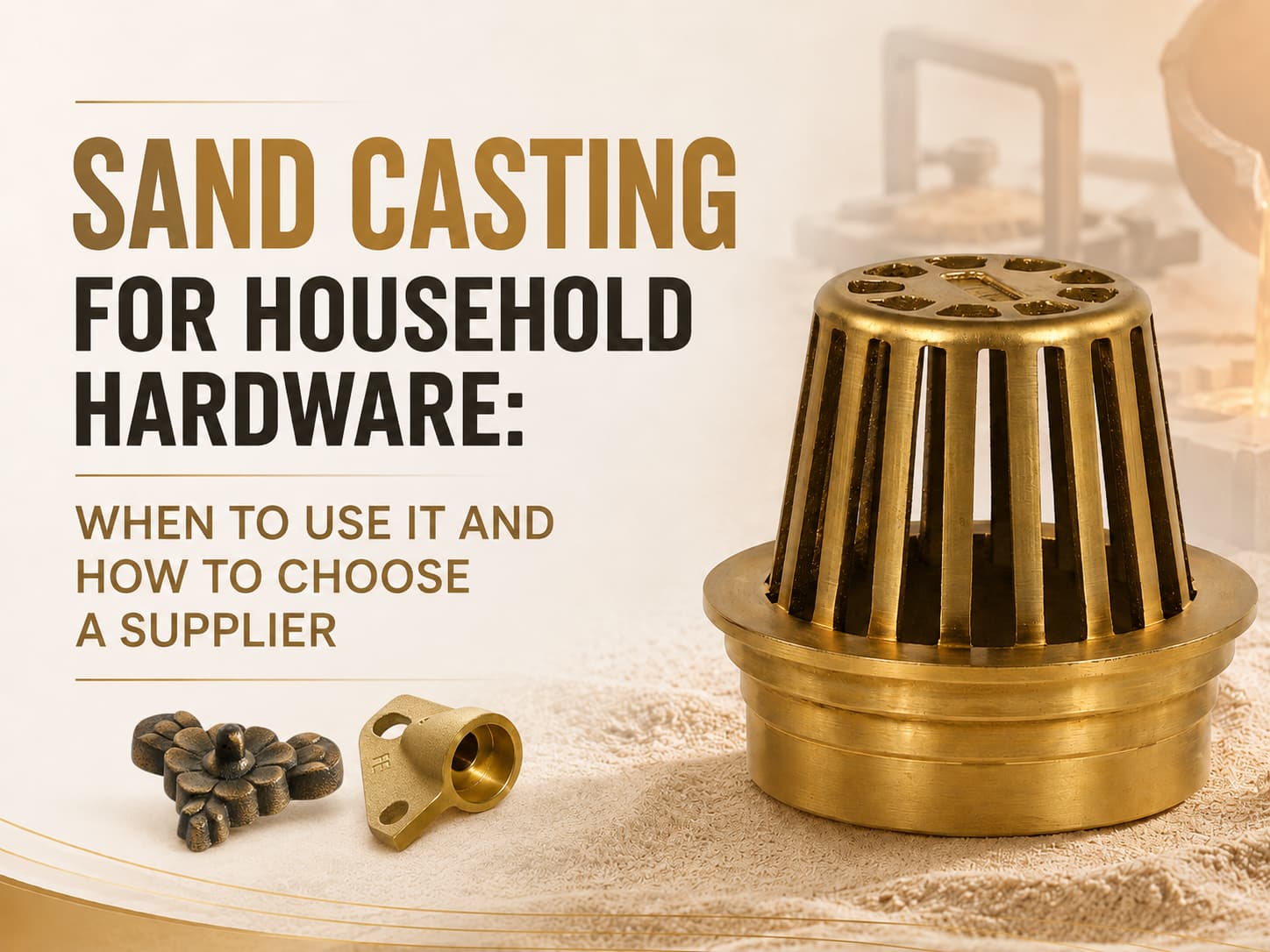
At King Shine Resource Co., Ltd., we support household hardware projects by supplying metal components such as handles, hinges, fittings, brackets, and other functional hardware parts. For many buyers, the challenge isn’t simply producing a part—it’s achieving stable quality, consistent appearance, and predictable cost across samples and production runs.
That’s where sand casting becomes a practical solution. It offers strong design flexibility and reasonable tooling cost, especially for medium-to-large household hardware components that may require machining and surface finishing.
Why Sand Casting Works Well for Household Hardware
Household hardware often needs a balance of strength, manufacturability, and surface quality. Sand casting is a good fit when your design includes thicker sections, structural features, or customized geometry.
Sand casting is especially useful when you need:
- Design flexibility for custom shapes, ribs, bosses, and mounting structures
- Cost-effective tooling compared with high-volume processes
- Multiple material options (brass, bronze, stainless steel, aluminum) depending on durability and corrosion needs
- A practical way to form thicker parts that would be costly to machine from solid stock
Typical Household Hardware Parts That Fit Sand Casting
Sand casting is commonly used when parts are functional, robust, and designed to be finished with machining and surface treatment.
Examples include:
- Heavy-duty handles and knobs (especially thicker styles)
- Hinge bodies and structural hinge components
- Fittings and connectors with customized geometry
- Mounting brackets, bases, covers, and supports
- Hardware components that will be machined (threads, flat faces, bores) and then finished (polishing, coating, plating)
The Sand Casting Workflow for Stable Production
To deliver consistent household hardware parts, the process must be controlled from the start—not only at pouring, but also during inspection and finishing.
1) Raw Material Stage
We confirm alloy grade and ensure stable supply, then control chemical composition and cleanliness for consistent casting behavior.
2) Modeling Stage
We prepare patterns and mold strategy with proper draft and allowances to support repeatability and minimize casting defects.
3) Casting and Rough Casting Treatment
We melt and pour under controlled conditions, then perform trimming, cleaning, and basic rough treatment to stabilize the casting for measurement and finishing.
4) Dimensional and Visual Inspection of Castings
We inspect key dimensions and visual condition early to catch issues before machining—reducing rework and avoiding downstream cost.
5) Determine Whether Machining or Other Requirements Are Needed
This is a major cost-control step for household hardware. We confirm exactly which areas need machining or additional requirements such as polishing, coating, plating, or testing.
6) Machining and Inspection
We machine only the functional surfaces (threads, mounting faces, sealing or fit areas), then verify critical dimensions after machining.
7) Inspection, Packaging, and Shipping
Final outgoing inspection confirms appearance and key specs, followed by protective packaging to prevent scratches and corrosion during transport.
When to Use Sand Casting (and When Not to)
Sand casting is a strong option when:
- Your household hardware part is medium to large, or has thicker sections
- You need custom shapes or multiple variants
- You want reasonable tooling cost and flexibility for design changes
- Machining and surface finishing are acceptable to reach final fit and appearance
You may consider other processes when:
- You need very fine detail and thin walls with premium surface finish (lost wax casting)
- Your part is mainly cylindrical/hollow and you want dense walls with low porosity (centrifugal casting)
- You need very high volume and simpler geometry (die casting may be better)
How to Choose a Supplier for Sand-Cast Household Hardware
1) Ability to Support Both Casting and Post-Processing
Household hardware often needs machining, polishing, plating, or coating. A reliable supplier should be able to coordinate the full flow, not only deliver a rough casting.
2) Clear Control of “As-Cast vs. Machined” Scope
A good supplier will ask the right questions:
- Which surfaces are functional?
- Which dimensions truly need tight tolerance?
- Which areas should remain as-cast to control cost?
3) Material Guidance for Durability and Corrosion Resistance
Household hardware may face humidity, cleaning chemicals, and long-term wear. A supplier should help confirm the best alloy choice—brass, bronze, stainless steel, or aluminum—based on environment and cost.
4) Quality Inspection and Traceability
Look for suppliers that can provide dimensional inspection, visual checks, and documentation that matches your purchasing requirements—especially if you manage multiple SKUs.
5) Packaging Know-How for Export and Appearance Protection
Hardware is appearance-sensitive. Packaging should prevent scratches, dents, and corrosion—especially for plated or polished surfaces.
Cost-Saving Tips for Buyers (Practical DFM Notes)
- Avoid over-spec tolerances on non-functional surfaces
- Standardize features across variants when possible
- Plan finishing early so casting allowances match polishing/plating needs
- Clearly label as-cast vs. machined vs. finished areas on drawings
Conclusion
For household hardware sourcing, sand casting is often the most practical route when your part needs shape flexibility, structural strength, and controlled cost—especially when paired with the right machining scope and finishing plan.
If you are developing or sourcing household hardware parts and want a stable supplier for sand casting plus machining and finishing coordination, contact King Shine Resource Co., Ltd. Share your drawings/specs, and we will recommend the best process route and provide an RFQ for your project.