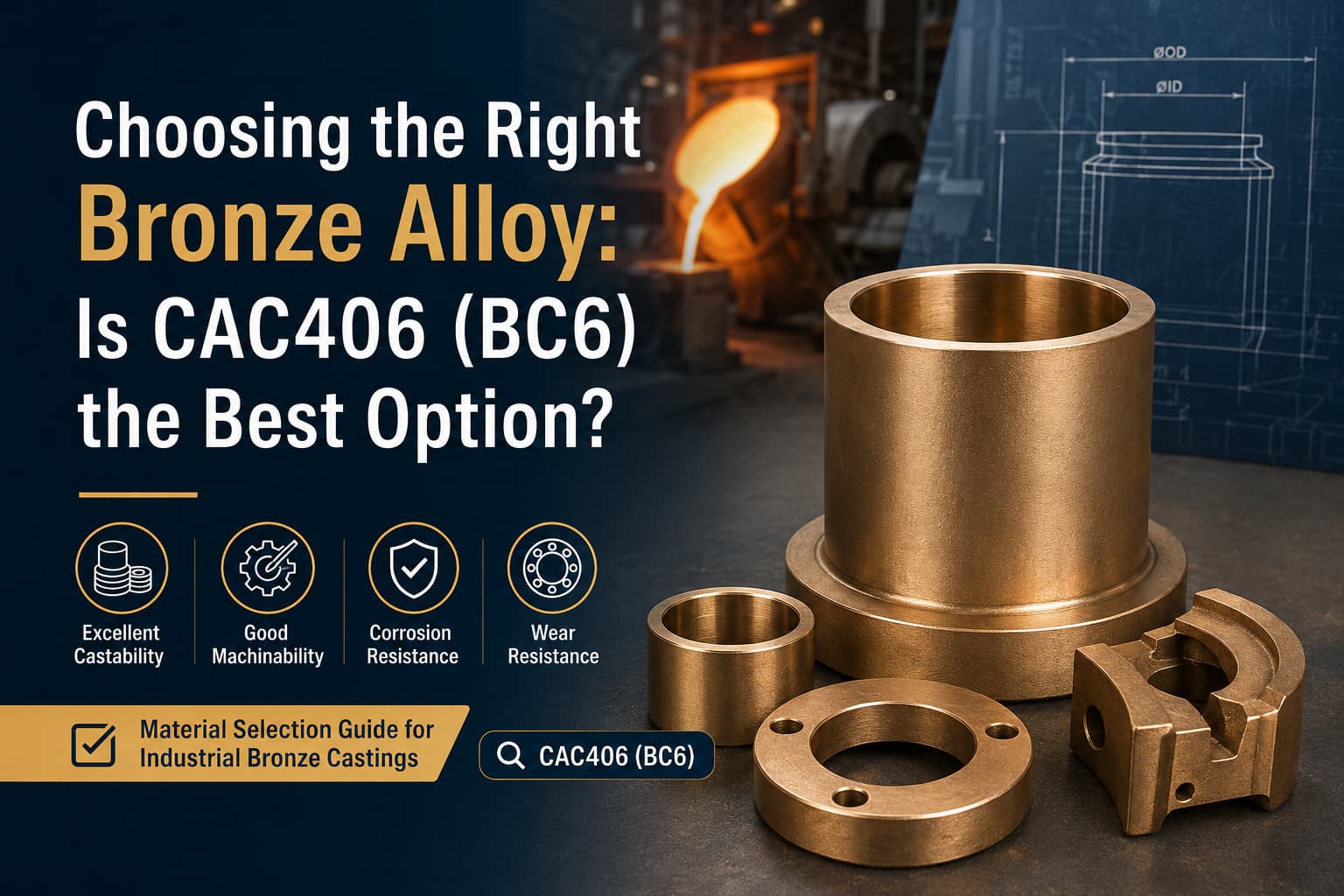
Selecting the wrong bronze alloy can lead to premature wear, corrosion, machining difficulties, regulatory concerns, or unnecessary material costs. CAC406, also known as BC6, is widely used for cast and machined bronze components—but its popularity does not mean it is the best choice for every project.
The right decision depends on the component’s operating environment, load, wear conditions, machining requirements, lead restrictions, geometry, and casting process.
Table of Contents
- When Is CAC406 (BC6) a Good Choice?
- CAC406 Selection at a Glance
- What Is CAC406 (BC6)?
- Where Is CAC406 Commonly Used?
- Three Practical Selection Scenarios
- When CAC406 May Not Be the Best Option
- CAC406 vs. Other Bronze Alloy Options
- How Part Geometry Affects the Casting Method
- What Buyers Should Confirm Before Ordering
- Is CAC406 Right for Your Part?
Quick Answer: When Is CAC406 (BC6) a Good Choice?
CAC406 can be a practical choice for bushings, sleeves, valve components, pump parts, fittings, and general machinery components that require:
- Good castability
- Stable machining performance
- Moderate wear resistance
- General corrosion resistance
- Reliable production at a reasonable total cost
However, CAC406 may not be the best option for components exposed to seawater, aggressive chemicals, extremely heavy loads, severe wear, or lead-restricted applications. These conditions may require aluminum bronze, lead-free bronze, phosphor bronze, nickel copper, or another specialized copper alloy.
Buyers should ask whether CAC406 matches the actual environment, load, machining plan, compliance requirements, and production method of the component.
CAC406 Selection at a Glance
The following table provides an initial reference for determining whether CAC406 deserves further evaluation.
| Selection Factor | CAC406 May Be Suitable When… | Consider Another Alloy When… |
|---|---|---|
| Operating environment | The part is used in freshwater or a general industrial environment. | The part faces seawater, aggressive chemicals, or severe corrosion. |
| Mechanical load | The component operates under moderate load and wear. | The component carries heavy loads, impact, or severe sliding wear. |
| Machining requirements | Bores, threads, sealing faces, or other surfaces require finish machining. | Strength or corrosion performance is more important than machining efficiency. |
| Lead requirements | Lead-containing bronze is permitted for the application and market. | Lead-free compliance is required. |
| Component type | The part is a bushing, sleeve, valve component, fitting, or machinery part. | The part has highly specialized mechanical or environmental requirements. |
| Production method | The component will be cast and subsequently machined. | The design requires a special forming process or another material system. |
What Is CAC406 (BC6)?
CAC406 is a cast copper alloy commonly used for industrial bronze components. BC6 is its former JIS designation and remains a familiar name in many drawings, purchasing documents, and supply chains.
Its main advantage is not that it delivers the highest performance in one particular category. Instead, it offers a useful combination of:
- Castability
- Machinability
- Wear resistance
- Corrosion resistance
- Production stability
This balanced performance makes CAC406 suitable for many components that are first cast and then machined to achieve their final dimensions, bores, threads, sealing surfaces, or mounting features.
Before specifying CAC406, buyers should also confirm the required material standard and composition with the supplier. Requirements may vary according to the drawing, destination market, customer specification, and applicable regulations.
Where Is CAC406 Commonly Used?
CAC406 may be considered for:
- Bushings and sleeves
- Valve bodies and valve components
- Pump-related parts
- Fittings and connectors
- Machinery hardware
- Sliding or rotating components
- General-purpose bronze castings
- Components requiring secondary machining
Its suitability still depends on the actual operating conditions. A material that performs well in a lightly loaded machinery bushing, for example, may not be appropriate for a heavily loaded bearing surface or a component continuously exposed to seawater.
Three Practical CAC406 Selection Scenarios
Scenario 1: A General Machinery Bushing
A machinery bushing requires casting, internal bore machining, and stable dimensional control. It operates under moderate load in a normal industrial environment without severe corrosion.
In this situation, CAC406 may be a practical candidate because it provides a useful balance of machinability, wear resistance, and production cost.
Before confirming the material, the buyer should still provide:
- Operating load
- Shaft speed
- Lubrication conditions
- Required clearance
- Surface finish
- Dimensional tolerance
If the bushing operates under unusually high load, poor lubrication, or continuous high-speed movement, a more specialized bearing bronze may be required.
Scenario 2: A Marine Valve Component
A valve component used near seawater requires corrosion resistance as well as reliable casting quality.
Although CAC406 provides general corrosion resistance, that does not automatically make it the best choice for prolonged seawater exposure. Aluminum bronze or another marine-grade copper alloy may offer better strength and corrosion performance, depending on the fluid, pressure, temperature, and service conditions.
For marine applications, material selection should therefore consider more than the word “bronze” on the drawing.
Scenario 3: A Fluid-Handling Component with Lead Restrictions
CAC406 may appear suitable because the part requires good castability and extensive machining. However, the product will be used in an application or destination market with restrictions on lead content.
In this case, a lead-free copper alloy should be evaluated even if it results in different machining behavior, material cost, or casting requirements.
Compliance requirements must be confirmed before quotation and production—not after tooling, casting, or machining has already begun.
When CAC406 May Not Be the Best Option
CAC406 should not be treated as a universal bronze material. Another alloy may be more suitable when:
- The part is continuously exposed to seawater
- The operating environment contains aggressive chemicals
- Very high mechanical strength is required
- The component operates under heavy load or severe wear
- The part experiences high impact or demanding fatigue conditions
- Lead content is restricted
- Special pressure, temperature, or hygiene requirements apply
Choosing a more specialized alloy can increase the initial material or processing cost. However, specifying CAC406 only to reduce the purchase price may create greater costs later through premature failure, excessive maintenance, compliance problems, or shortened service life.
CAC406 vs. Other Bronze Alloy Options
| Material Option | Suitable Starting Point For | Main Advantage | Important Consideration |
|---|---|---|---|
| CAC406 (BC6) | General castings, bushings, sleeves, valve parts, and machined components | Balanced castability, machinability, wear, and corrosion performance | Not ideal for every severe-corrosion or heavy-load application |
| Aluminum bronze | Marine, high-strength, and heavy-duty components | High strength and strong corrosion resistance | Machining and casting may be more demanding |
| Phosphor bronze | Components requiring wear and fatigue resistance | Good wear and fatigue performance | Suitability depends on the exact grade and application |
| Lead-free bronze | Regulated fluid-handling or lead-restricted products | Helps meet lead-content requirements | Machining behavior and cost may differ from CAC406 |
| Nickel copper or special copper alloy | Harsh or highly corrosive environments | Strong corrosion performance | Higher material and processing costs may apply |
These material families include multiple grades. Final selection should be based on the required standard and operating conditions rather than the alloy family name alone.
How Part Geometry Affects the Casting Method
Selecting CAC406 is only one part of the production decision. The casting method affects material yield, wall quality, machining allowance, dimensional capability, and total cost.
Centrifugal Casting
Centrifugal casting is especially suitable for rotationally symmetrical components such as:
- Bushings
- Sleeves
- Rings
- Liners
- Hollow cylindrical parts
The process can help produce a dense working wall and is worth evaluating when the component requires substantial internal or external machining.
Sand Casting
Sand casting can be suitable for medium-to-large components, robust sections, and geometries that require flexible production without highly complex tooling.
It may be a practical option when the part will receive secondary machining and its design is not limited to a rotationally symmetrical shape.
Investment Casting
Investment casting may be considered for smaller or more complex parts that require better surface finish, detailed geometry, or a near-net-shape result.
However, selecting a casting method should not be based on surface appearance alone. Quantity, tolerances, machining allowance, material behavior, tooling cost, and inspection requirements must also be considered.
What Should Buyers Confirm Before Ordering CAC406 Castings?
To evaluate the material and production method accurately, buyers should provide more than a material name. The following information helps the supplier understand the actual project requirements:
- Drawing and dimensions
Include critical tolerances, wall thicknesses, machining areas, and surface-finish requirements. - Operating environment
Clarify whether the part will contact freshwater, seawater, oil, steam, chemicals, or another medium. - Load and movement
Specify whether the component carries static load, sliding load, rotating load, impact, or repeated movement. - Machining requirements
Identify bores, threads, sealing faces, mounting surfaces, and other critical features. - Applicable material standard
Confirm the required grade, specification, composition, certification, and destination-market requirements. - Lead restrictions
State whether the application or market requires a lead-free material. - Inspection requirements
Indicate whether dimensional inspection, material certification, pressure testing, or non-destructive testing is required. - Order quantity
Prototype, small-batch, and repeat-production projects may require different casting and tooling strategies.
Providing this information early allows the alloy, casting method, machining scope, and inspection plan to be evaluated together.
Is CAC406 the Right Bronze Alloy for Your Part?
CAC406 can be a cost-effective and reliable option for many bushings, sleeves, valve components, fittings, and machinery parts. It is particularly useful when the project requires good castability, efficient machining, moderate wear resistance, and general corrosion performance.
However, it should not be selected simply because it is familiar or widely available.
If the component faces seawater, aggressive chemicals, heavy loads, severe wear, or lead restrictions, another copper alloy may deliver better long-term performance.
King Shine Resource Co., Ltd. evaluates bronze alloy selection together with part geometry, casting process, machining requirements, inspection needs, and final application. This integrated review helps buyers avoid choosing a material that appears acceptable on paper but does not match the actual production or operating conditions.
Need Help Selecting a Bronze Alloy?
Not sure whether CAC406 (BC6) is suitable for your component? Share your drawings, samples, operating conditions, required standards, and estimated quantity with King Shine Resource Co., Ltd.
Our team can help evaluate the appropriate bronze alloy, casting method, machining scope, inspection requirements, and production plan for your project.
Contact Us