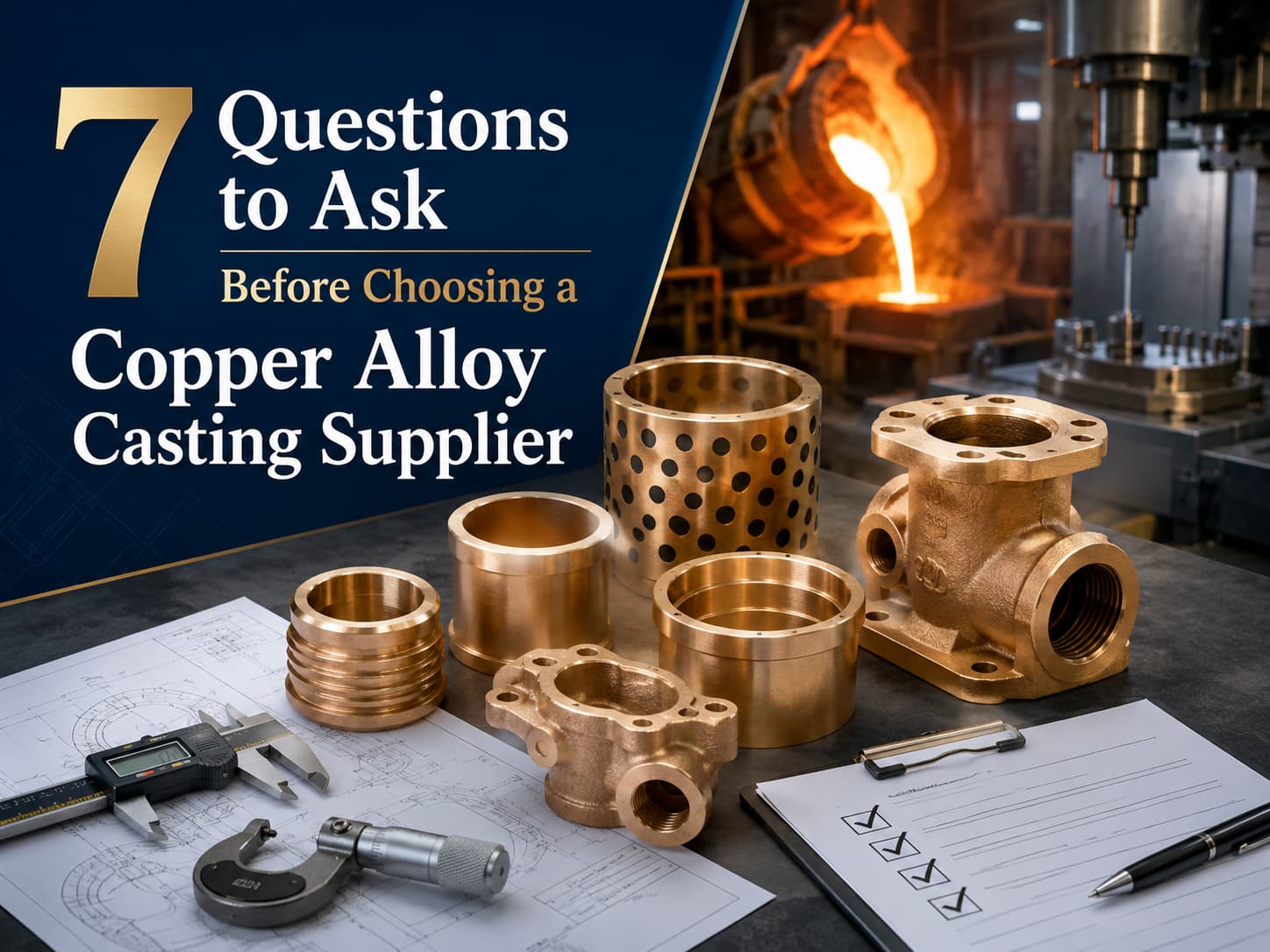
Choosing a copper alloy casting supplier is not just about finding someone who can pour metal into a mold. For B2B buyers, the real concern is whether the supplier can consistently deliver cast parts that meet drawing requirements, material expectations, machining needs, inspection standards, and delivery schedules.
Copper alloy castings are widely used in industrial parts, marine hardware, valve components, bushings, sleeves, fittings, and machinery hardware because they offer useful performance characteristics such as corrosion resistance, wear resistance, machinability, and durability. However, not every copper alloy—or every casting process—is suitable for every application.
At King Shine Resource Co., Ltd., we support copper alloy casting projects by helping customers evaluate material selection, casting method, machining scope, and inspection requirements before production begins. Before choosing a supplier, here are seven questions every B2B buyer should ask.
1. What Copper Alloy Materials Can the Supplier Support?
The first question is simple but critical: Can the supplier support the copper alloy your part actually needs?
In industrial sourcing, “copper alloy casting” may include several material families, such as:
- Brass
- Bronze
- Phosphor bronze
- Aluminum bronze
- Lead bronze
- Nickel copper
- CAC406 / BC6
- Other specialty copper alloys
Each material behaves differently in terms of castability, machinability, corrosion resistance, wear resistance, and cost. For example, a general machinery bushing may not need the same alloy as a marine component exposed to seawater. A valve part that requires pressure tightness may also need a different material strategy from a decorative household hardware component.
Before choosing a supplier, ask whether they can help you compare materials—not just accept the material name on your drawing. If you are evaluating bronze options, our article Choosing the Right Bronze Alloy: Is CAC406 (BC6) the Best Option? explains how buyers can think about CAC406 / BC6 and other bronze alloy choices.
A reliable copper alloy casting supplier should help confirm:
- Whether the selected alloy matches the application environment
- Whether the alloy is suitable for the casting method
- Whether the material can be machined efficiently
- Whether there are lead restrictions or compliance concerns
- Whether a more cost-effective or more durable alloy should be considered
Choosing the wrong alloy may cause problems later, including premature wear, corrosion failure, machining difficulty, or higher-than-expected production cost.
2. Which Casting Process Is Best for the Part?
A strong supplier should not force every project into the same manufacturing route. Copper alloy parts can be produced through different casting processes depending on geometry, size, tolerance, surface finish, and performance requirements.
Common casting methods include:
- Sand casting for medium-to-large parts and flexible geometry
- Investment casting / lost wax casting for smaller complex parts with finer detail
- Centrifugal casting for cylindrical, hollow, or rotationally symmetric parts requiring higher density
- Furan casting for robust parts where stable mold strength is important
For example, if your part is a sleeve, bushing, ring, liner, or tube-shaped component, centrifugal casting may be the better choice because it uses rotational force to form a dense working wall. If your part has complex detail, thin sections, or a cleaner surface requirement, investment casting may be more suitable. If the part is large, thick, or shape-flexible, sand casting may be the practical route.
If you are still comparing processes, you can read Centrifugal vs. Sand vs. Investment Casting: Which Method Fits Your Project? for a broader process comparison.
The key question to ask your supplier is:
“Which casting process do you recommend for this part, and why?”
A capable supplier should explain the trade-offs clearly, including:
- Tooling cost
- Part size limits
- As-cast tolerance
- Surface finish
- Machining allowance
- Production volume
- Risk of porosity or shrinkage
- Final inspection requirements
This helps buyers avoid choosing a process based only on price while overlooking long-term production stability.
3. Can the Supplier Control Material Quality and Composition?
For copper alloy castings, material control is one of the foundations of quality. Small changes in composition can affect strength, corrosion resistance, machining behavior, and casting performance.
A qualified copper alloy casting supplier should have a clear process for raw material control, including:
- Raw material confirmation
- Alloy grade identification
- Melting control
- Composition analysis
- Material traceability
- Documentation when required
This is especially important when the part will be used in marine, valve, pump, machinery, or pressure-related applications. If the material is unstable, even a well-designed part may fail in service.
Buyers should ask:
- Can you confirm the material grade before production?
- Do you perform composition analysis?
- Can you provide material certificates if needed?
- How do you control material consistency across repeat orders?
- What happens if the test result does not match the required range?
King Shine’s Material page lists copper alloy material options and reference properties. Buyers can use this kind of information as a starting point when discussing material requirements with the supplier.
A good supplier should not treat material as a minor detail. Material selection and material control directly affect the final casting’s performance and reliability.
4. Can the Supplier Support Machining After Casting?
Most B2B copper alloy castings are not used immediately after casting. Many parts require machining to achieve final dimensions, surface finish, and assembly fit.
Common machined features include:
- Inner diameters
- Outer diameters
- Bores
- Threads
- Sealing faces
- Mounting surfaces
- End faces
- Grooves
- Chamfers
- Datums for inspection or assembly
This is especially important for bushings, sleeves, valve components, pump parts, and machinery hardware. A casting may form the primary shape, but machining often determines whether the part can actually be assembled and used.
Before choosing a supplier, ask:
- Can you support machining based on drawings?
- Which surfaces should be left as-cast?
- Which surfaces should be machined?
- How much machining allowance should be planned?
- Can you maintain concentricity, flatness, or other functional tolerances?
- Can you inspect the part after machining?
This is also where cost control becomes important. If a drawing does not clearly separate as-cast features from machined features, the quotation may become inaccurate. The supplier may either overquote to cover risk or underquote and later request cost adjustments.
A strong supplier should help buyers review the drawing and identify which areas truly need precision machining and which areas can remain cost-efficient as-cast.
5. What Inspection and Testing Can the Supplier Provide?
A copper alloy casting supplier should be able to support inspection requirements that match the application risk. Not every part needs advanced testing, but every project needs a clear inspection plan.
Common inspection items include:
- Dimensional inspection
- Visual inspection
- Surface defect checks
- Material verification
- Machining inspection
- Pressure or leak testing when required
- Documentation and inspection reports
For example, a decorative hardware component may focus on appearance and basic dimensions, while a valve component may require sealing face inspection, pressure testing, and material confirmation. A large centrifugal copper alloy sleeve may require dimensional checks on ID, OD, length, wall thickness, and concentricity.
For centrifugal casting projects, inspection is especially important because buyers often care about density, wall integrity, and final machining quality. If you want to understand this process better, you can read What Is Centrifugal Casting? or review King Shine’s Centrifugal Casting Process.
Before confirming an order, ask:
- What inspections are included in the standard quote?
- Can you provide dimensional reports?
- Can you provide visual inspection standards?
- Do you support air pressure or water pressure testing when needed?
- Can inspection be done before machining to avoid wasted machining time?
- Can final inspection be done after machining and finishing?
Inspection should not be treated as an afterthought. It should be planned together with the casting process, machining scope, and application requirements.
6. Can the Supplier Handle Your Part Size and Dimensional Requirements?
Part size is one of the most important factors when choosing a copper alloy casting supplier. A supplier may be capable of small bronze parts but not large centrifugal copper castings. Another supplier may handle large sand castings but not precision investment cast parts.
Buyers should confirm whether the supplier can support:
- Outer diameter
- Inner diameter
- Length
- Wall thickness
- Weight
- Machining allowance
- Final machined dimensions
- Shrinkage planning
- Packaging and shipping for large parts
For large cylindrical copper alloy parts, centrifugal casting dimensions and shrinkage planning become especially important. King Shine provides a Centrifugal Casting Copper Alloy Dimensions reference for buyers evaluating large copper alloy centrifugal casting projects.
The key question is not only:
“Can you cast this size?”
The better question is:
“Can you cast this size and still help us achieve the final machined dimensions?”
This distinction matters because large copper alloy castings often need to account for shrinkage, rough machining, finish machining, and inspection. A supplier that does not understand this planning may produce a casting that looks acceptable at first but becomes difficult or impossible to machine to final drawing requirements.
7. Does the Supplier Understand B2B RFQ Requirements?
For industrial buyers, a successful project starts with a clear RFQ. A good supplier should be able to review your requirements and ask the right questions before quotation.
A complete RFQ should include:
- 2D drawing or 3D file
- Material grade
- Annual quantity or estimated batch size
- Application environment
- Casting process preference, if known
- As-cast vs. machined surfaces
- Critical dimensions and tolerances
- Surface finish requirements
- Heat treatment or surface treatment needs
- Inspection requirements
- Packaging and delivery expectations
If the supplier quotes without asking about these details, the quotation may not reflect the actual production cost or risk.
For example, two parts with the same shape may have very different pricing if one requires:
- Tight bore tolerance
- Pressure testing
- Polished surface finish
- Corrosion-resistant alloy
- 100% inspection
- Special packaging for export
A reliable copper alloy casting supplier should help clarify these requirements early. This reduces quotation revisions, production delays, and disputes after delivery.
Why Work with King Shine Resource Co., Ltd.?
For B2B buyers, choosing a copper alloy casting supplier is not only about production capacity. It is also about whether the supplier can help evaluate the right material, the right casting process, and the right finishing plan before cost and quality problems occur.
King Shine Resource Co., Ltd. supports customers across multiple casting methods, including sand casting, investment casting, centrifugal casting, and furan casting. This allows us to recommend a suitable process based on part geometry, size, tolerance expectations, surface requirements, and application environment rather than forcing every project into one manufacturing route.
We also help customers review drawings or samples, clarify as-cast versus machined features, plan machining allowances, and define inspection requirements. For industrial parts such as marine hardware, valve components, bushings, sleeves, rings, and machinery hardware, this early-stage support helps reduce quotation uncertainty, machining waste, rework risk, and delivery delays.
Bonus: Signs of a Reliable Copper Alloy Casting Supplier
Beyond the seven questions above, B2B buyers can also look for practical signs of supplier reliability.
A strong supplier should be able to:
- Recommend suitable casting methods based on part geometry
- Explain material options clearly
- Support both casting and machining planning
- Identify cost-saving opportunities without weakening function
- Review tolerances and suggest practical alternatives
- Provide inspection and documentation when required
- Support export packaging and delivery coordination
- Communicate clearly during RFQ, sampling, and production
In short, the best supplier is not simply the one with the lowest unit price. It is the supplier that helps reduce total risk across material, process, machining, inspection, and delivery.
Conclusion
Choosing a copper alloy casting supplier is a technical sourcing decision. The right partner should help you answer more than “Can this part be cast?” They should help determine which alloy is suitable, which casting method fits the geometry, which surfaces need machining, what inspection is required, and how the final part can meet your application requirements reliably.
Before choosing a supplier, ask these seven questions:
- What copper alloy materials can the supplier support?
- Which casting process is best for the part?
- Can the supplier control material quality and composition?
- Can the supplier support machining after casting?
- What inspection and testing can the supplier provide?
- Can the supplier handle your part size and dimensional requirements?
- Does the supplier understand B2B RFQ requirements?
If you are sourcing copper alloy castings for machinery, marine hardware, valve components, bushings, sleeves, rings, or other industrial parts, King Shine Resource Co., Ltd. can help review your drawings or samples, recommend suitable materials and casting methods, and provide a quotation plan based on your tolerance, machining, inspection, and delivery needs.