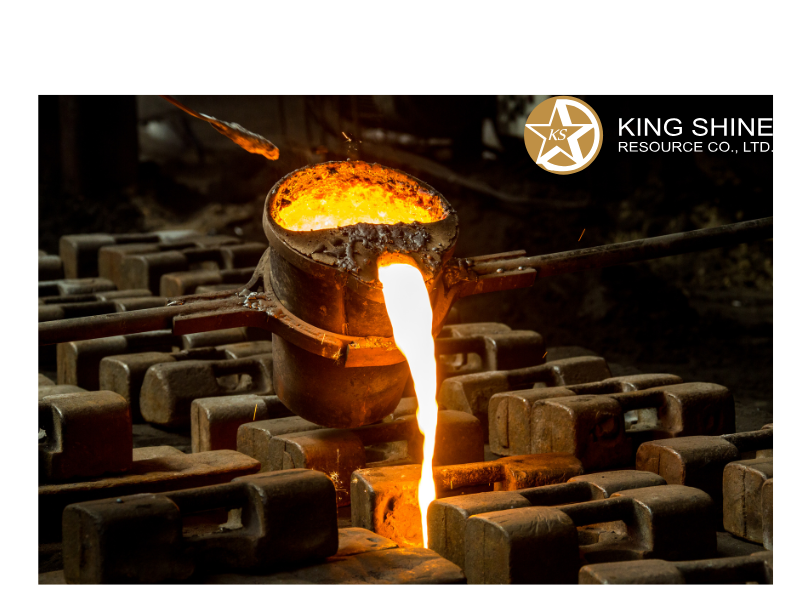
At KING SHINE, sand casting remains a versatile and cost-effective route from concept to metal for marine hardware, valve components, and machinery parts. The workflow below follows the wording and sequence used on our site—from materials to shipment—and includes the decision point for machining and other requirements.
Raw Material Stage
We confirm the required alloy and specification based on drawings and performance needs (e.g., brass, bronze, stainless steel, or aluminum). Each heat is checked for chemical composition and cleanliness to ensure full traceability from the start.
- Alloy grade and melt source confirmation
- Inbound material inspection, identification, and documentation
- Stock planning for samples, pilot runs, and mass production
Modeling Stage
Patterns, cores, and process tooling are prepared to realize geometry with proper allowances and stable molding conditions.
- Pattern preparation with draft and machining allowance for clean release and predictable finishing stock
- Core making & core setting for internal cavities, using suitable binders/core prints for dimensional stability
- Gating & riser design to balance flow, feeding, and directional solidification to reduce porosity/shrinkage
- Mold assembly (cope/drag) with parting line control, mold hardness checks, and cavity surface review
Outcome: a stable mold system that supports accurate filling and predictable solidification.
Casting and Rough Casting Treatment
Alloys are melted under controlled temperature and chemistry, then poured through the engineered gating system to completely fill the cavity.
During casting
- Temperature and pouring rate control; slag management to limit gas/oxide defects
- Real-time checks on sprue/runners/venting to avoid turbulence and misruns
Rough casting treatment (after solidification & shakeout)
- Gate/runner/riser removal (fettling)
- Shot blasting / cleaning to remove residual sand and scale; reveal surface condition
- Initial deburring / trimming to prepare for inspection and possible machining
- Optional heat treatment prior to precision finishing if specified
Dimensional and Visual Inspection of Castings
The cleaned rough casting undergoes dimensional and cosmetic checks to confirm as-cast compliance with drawing intent.
- Dimensional inspection (gauges/CMM) on as-cast datums and critical features
- Visual inspection for cold shuts, misruns, burn-on sand, and incomplete filling
- Basic integrity checks or specified NDT sampling as required
Determine Whether Machining or Other Requirements Are Needed
We evaluate drawings and tolerance targets to decide if finish machining, surface treatment, or additional testing is required.
- Tight tolerances on bores, sealing faces, threaded features
- Defined surface finish (Ra/Rz), flatness, perpendicularity, coaxiality/runout
- Special processes: heat treatment, coating/plating, pressure or leak tests, 100% NDT
If no further operations are needed, the part proceeds to final inspection, packaging, and shipping. If yes, it continues to machining and inspection.
Machining and Inspection
When tighter control is required, castings enter precision machining followed by in-process and final measurements.
- Facing, boring, reaming, threading, milling of mounting faces and sealing seats
- Datum strategy maintained to protect GD&T features (flatness, runout, perpendicularity, concentricity)
- Post-machining inspection: dimensional verification (CMM/functional gauges), surface finish checks, and specified NDT/pressure tests
Inspection, Packaging, and Shipping
All products pass a final outgoing inspection before dispatch.
- Final inspection: dimensional spot-check or 100% per contract; visual review; documentation pack (material certs, inspection reports, heat-treat records)
- Packaging: protective wrapping, corrosion inhibitors if needed, carton/pallet planning for safe transit
- Shipping: labeling, export documents, and logistics coordination to meet delivery schedules
Conclusion
Following the sequence—raw material stage → modeling stage → casting and rough casting treatment → dimensional and visual inspection of castings → determine whether machining or other requirements are needed → (if yes) machining and inspection → inspection, packaging, and shipping—KING SHINE delivers consistent, traceable, and durable cast components from sample to mass production.