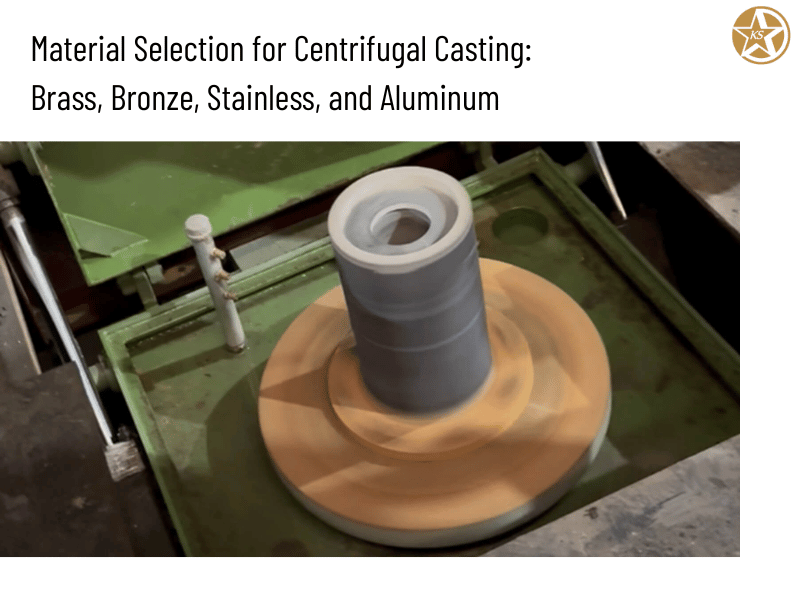
At King Shine Resource Co., Ltd., centrifugal casting excels at producing dense, defect-resistant cylindrical or hollow parts—bushings, sleeves, bearings, valve seats, and rings. This guide compares brass, bronze, stainless steel, and aluminum for centrifugal casting: how each behaves in the spinning mold, what properties to expect, and how to choose the best fit for your application.
What the Process Demands from Materials
- Fluidity & oxide behavior: Fill thin walls quickly while minimizing oxidation/inclusions at the bore.
- Hot strength & shrinkage: Resist hot tearing; predictable shrinkage for sound, straight tubes/sleeves.
- Segregation control: Centrifugal force drives inclusions to the bore; cleanliness and process control are key.
- Machinability after casting: Most parts require finish machining on ID/OD; chip control and tool life matter.
- Service conditions: Corrosion, wear, and temperature drive alloy family and heat treatment choice.
Brass (Cu–Zn Alloys)
Where it shines: Low to moderate loads, plumbing/valve seats, decorative or lightly corrosive environments.
- Process behavior: Good fluidity and relatively low melting temperatures; suitable for thin sections.
- Properties: Decent strength/ductility; fair wear resistance; watch dezincification unless DZR grades are used.
- Machinability: Excellent—short chips and clean finishes lower cycle time.
- Choose when: Cost-sensitive components where moderate corrosion resistance is sufficient.
Watchouts: In aggressive water or chloride exposure, specify dezincification-resistant brasses.
Bronze (Cu–Sn / Cu–Sn–Pb / Aluminum Bronze)
Where it shines: Heavier loads, sliding/rotating pairs, and harsher corrosion—especially with aluminum bronze.
- Process behavior: Leaded bronzes machine easily and embed debris; aluminum bronzes need tighter control but offer premium strength/corrosion resistance.
- Properties: Tin bronzes = strong, good bearing fatigue; leaded bronzes = superb machinability & seizure resistance; aluminum bronzes = high strength and seawater resistance.
- Machinability: Tin bronzes moderate; leaded bronzes excellent; aluminum bronzes tougher—use rigid setups and sharp carbide.
- Choose when: Marine sleeves, heavy-duty bushings, pump components, seawater valve seats.
Stainless Steel (Austenitic, Martensitic, Duplex)
Where it shines: High corrosion resistance, pressure/temperature resistance, and structural integrity.
- Process behavior: Higher melting temperature/viscosity; control superheat and spin speed; strict melt cleanliness.
- Properties: Austenitic (304/316) = excellent corrosion & toughness; Martensitic (410/420) = high hardness after heat treat; Duplex = strong with chloride SCC resistance.
- Machinability: More challenging than copper alloys—manage work hardening with tooling and parameters.
- Choose when: Chemical/food sleeves, high-pressure rings, steam service, or highly aggressive environments.
Aluminum (Al–Si and Specialty Alloys)
Where it shines: Weight-critical parts with moderate strength and good corrosion resistance.
- Process behavior: Very good fluidity (especially Al–Si); manage hydrogen porosity with degassing/fluxing.
- Properties: Light weight, good thermal conductivity; reasonable wear resistance with design & heat treatment.
- Machinability: Excellent; ideal for thin-wall rings and high-speed machining.
- Choose when: Aerospace/transport sleeves, heat-transfer components, rotating parts needing inertia reduction.
Quick Comparison (Rules of Thumb)
| Criterion | Brass | Bronze (incl. Al-Bronze) | Stainless | Aluminum |
|---|---|---|---|---|
| Castability (thin walls) | ★★★★☆ | ★★★★☆ | ★★☆☆☆ | ★★★★★ |
| Corrosion resistance | ★★★☆☆ | ★★★★☆ (Al-Bronze ★★★★★) | ★★★★★ (grade-dependent) | ★★★★☆ |
| Wear/load capacity | ★★☆☆☆ | ★★★★☆ (Al-Bronze ★★★★★) | ★★★★☆ (martensitic) | ★★☆☆☆ |
| Machinability | ★★★★★ | ★★★★☆ (Al-Bronze ★★☆☆☆) | ★★☆☆☆ | ★★★★★ |
| Density (weight) | High | High | High | Low |
| Cost (relative) | $ | $$–$$$ | $$–$$$$ | $–$$ |
Stars are relative indicators; specific grades and heat treatments may shift outcomes.
Selection by Application
- Seawater bushings / marine sleeves: Aluminum bronze or duplex stainless.
- General bearings (moderate load): Leaded bronze for machinability and seizure resistance.
- Valve seats / potable water: DZR brass or 316 stainless for stricter corrosion/hygiene.
- High-temperature / steam rings: Martensitic stainless (heat-treated) or high-tin bronze.
- Lightweight rotating rings: Al–Si aluminum with strong porosity control and suitable heat treatment.
Process Tips to Maximize Results
- Spin speed & mold preheat: Tune for wall thickness and alloy; under-spin risks misruns, over-spin risks segregation.
- Melt cleanliness: Flux/degassing (Al), low-oxygen practice (Cu/Fe alloys), controlled superheat for stainless.
- Directional solidification: Manage OD chill; remove bore “cull” where inclusions concentrate.
- Heat treatment: Normalize/age where applicable (e.g., aluminum bronzes, stainless) to stabilize properties.
- Finish machining strategy: Leave allowance; control clamping to avoid ovality; verify ID/OD concentricity.
- NDT & documentation: UT for wall integrity, RT for critical pressure parts, and certificates for chemistry/heat treat.
Cost & Sustainability Considerations
- Yield & scrap: Dense walls with minimal cores; bore cull is recyclable.
- Energy & cycle time: Rapid wall solidification can shorten cycles vs. static molds.
- Alloy recyclability: Copper and aluminum alloys recycle efficiently; stainless scrap streams are mature.
- Total cost of ownership: Fewer defects reduce machining scrap and field failures.
Conclusion
No single alloy family wins every centrifugal casting job. Brass is cost-effective and easy to machine; bronze—especially aluminum bronze—covers heavy duty and marine; stainless conquers corrosive and high-pressure environments; aluminum delivers unmatched weight savings. Start with service conditions (corrosion, load, temperature), then overlay process factors (fluidity, shrinkage, cleanliness) and finishing needs (machinability, GD&T). Chosen well, centrifugal casting becomes a true competitive edge with King Shine Resource Co., Ltd. as your partner.