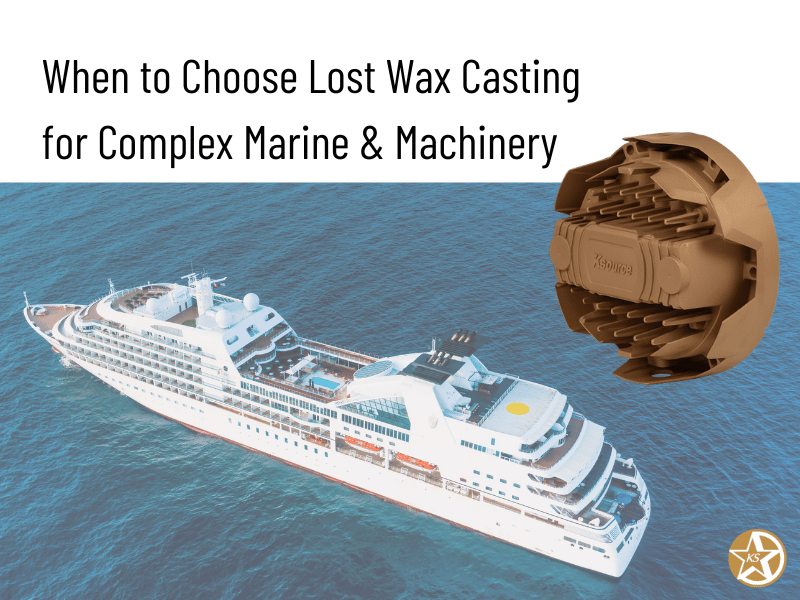
When to Choose Lost Wax Casting for Complex Marine & Machinery
When marine and machinery components become more compact, more integrated, and more performance-driven, manufacturing choices start to matter as much as design. Lost wax casting—also called investment casting—is often the best fit when you need intricate geometry, clean surfaces, and repeatable accuracy without excessive machining.
But it’s not always the right answer. In some cases, sand casting, centrifugal casting, forging, or die casting can deliver better economics or mechanical performance. This article explains when lost wax casting is the right choice for complex marine and machinery parts—and how to evaluate it before committing to tooling.
What Is Lost Wax Casting (Investment Casting)?
Lost wax casting is a precision casting method where a wax pattern is created, coated with ceramic slurry to form a shell, the wax is melted out (“lost”), and molten metal is poured into the ceramic mold. The result is a near-net-shape part that can capture fine details, thin walls, and complex contours.
For marine and machinery applications, investment casting is typically used for small-to-medium-sized parts that require complex shapes, reliable repeatability, better surface finish than sand casting, and fewer machining steps.
When Lost Wax Casting Makes the Most Sense
1) When Geometry Is Complex and Machining Would Be Expensive
If a part requires multi-axis machining, special fixturing, or multiple setups, lost wax casting can reduce machining time dramatically by delivering near-net geometry.
- Complex curves, ribs, bosses, and contours
- Integrated features that would otherwise be welded or assembled
- Shape-driven parts where CNC time dominates cost
Rule of thumb: If you’re designing “three pieces that must be welded together,” lost wax casting may allow the part to become one integrated casting.
2) When You Need Consistent Repeatability Across Batches
Marine hardware and machinery components often require consistent fit across assemblies. With controlled wax patterns and ceramic shells, investment casting supports stable repeatability across production runs—reducing rework and assembly variability.
3) When Surface Finish Matters
Marine parts are commonly exposed to salt spray and moisture. While corrosion resistance is driven mainly by alloy selection, a cleaner surface helps with sealing performance, coating adhesion, and appearance. Investment casting typically delivers a finer surface than sand casting, reducing heavy grinding and correction work.
4) When You Want Thin Walls or Fine Detail
Lost wax casting is often preferred for compact components with functional small features or thin walls—helpful when weight and space are constrained.
- Compact housings and brackets
- Lever arms, linkages, latch components
- Precision marine fittings where small geometry drives function
5) When Near-Net Shape Reduces Material Waste
If you are machining from solid bar/plate and generating significant chips—especially with stainless or copper alloys—investment casting can reduce waste and improve overall cost stability by producing closer-to-final geometry.
Marine Applications Where Lost Wax Casting Fits Well
- Marine hardware: cleats, hinges, latches, shackles, brackets (especially when aesthetics and smooth edges matter)
- Corrosion-resistant fittings: stainless or bronze components used in saltwater environments
- Pump and fluid components: housings, covers, small impellers (depending on geometry and flow design)
- Connector components: parts with complex transitions, tight fit, or integrated mounting features
Best-fit signals: complex shape + corrosion environment + batch repeatability requirements.
Machinery Applications Where Lost Wax Casting Fits Well
- Valve and flow-control components: bodies, bonnets, yokes, brackets (when external features are complex)
- Machine hardware: clamps, levers, mounting brackets, link arms
- Wear-prone parts: where predictable machining allowance and controlled material are required
- Compact housings: when sand casting would require too much machining cleanup
When You Should Not Choose Lost Wax Casting
Consider other processes if:
- The part is very large (sand casting may be more practical)
- The geometry is simple and machining is already efficient
- You need maximum grain flow and fatigue strength (forging may be superior)
- You need cylindrical hollow parts with dense walls (centrifugal casting is often ideal)
- You have very high volume with simple geometry (die casting or stamping may be more cost-effective)
Practical lens: investment casting is strongest when complexity drives cost and risk in other methods.
Design Tips to Make Lost Wax Casting Work Better
- Use consistent wall thickness where possible
- Avoid ultra-sharp internal corners; add fillets
- Machine only where needed (sealing faces, threads, bearing fits)
- Identify critical datums early for inspection and machining
- Clearly distinguish as-cast vs. machined features on the drawing
Quality & Inspection Considerations
- Dimensional checks (gauges/CMM) for critical geometry and mating features
- Visual inspection for surface integrity and casting flow issues
- NDT (when required) such as dye penetrant testing for surface cracks
- Material verification and traceability documentation for critical applications
The key is aligning the inspection level with the application risk—cosmetic marine hardware vs. safety- or pressure-related components.
Quick Process Comparison
| Process | Best For | Main Strength | Common Trade-Off |
|---|---|---|---|
| Lost Wax (Investment) Casting | Complex small-to-medium parts | Fine detail, better surface finish, near-net shape | Tooling cost and lead time for wax tooling |
| Sand Casting | Large or less detail-sensitive shapes | Flexible, cost-effective tooling | Lower finish/tolerance without machining |
| Centrifugal Casting | Cylindrical hollow parts | Dense walls, strong wear life | Limited to rotationally symmetric geometry |
| Forging | Strength-critical parts | High fatigue strength and grain flow | Geometry constraints; machining still needed |
Conclusion
Choose lost wax casting when your marine or machinery part is complex enough that machining, welding, or multi-part assembly becomes expensive— and when you need consistent repeatability, better surface quality, and fine feature detail. It’s often the smartest route for small-to-medium components where near-net shape saves time and improves reliability.
If you’re evaluating whether investment casting is the right fit for your design, King Shine Resource Co., Ltd. can help review your drawings, recommend the most suitable process (lost wax vs. sand vs. centrifugal vs. forging), and define the right balance of casting + machining + inspection for stable production.