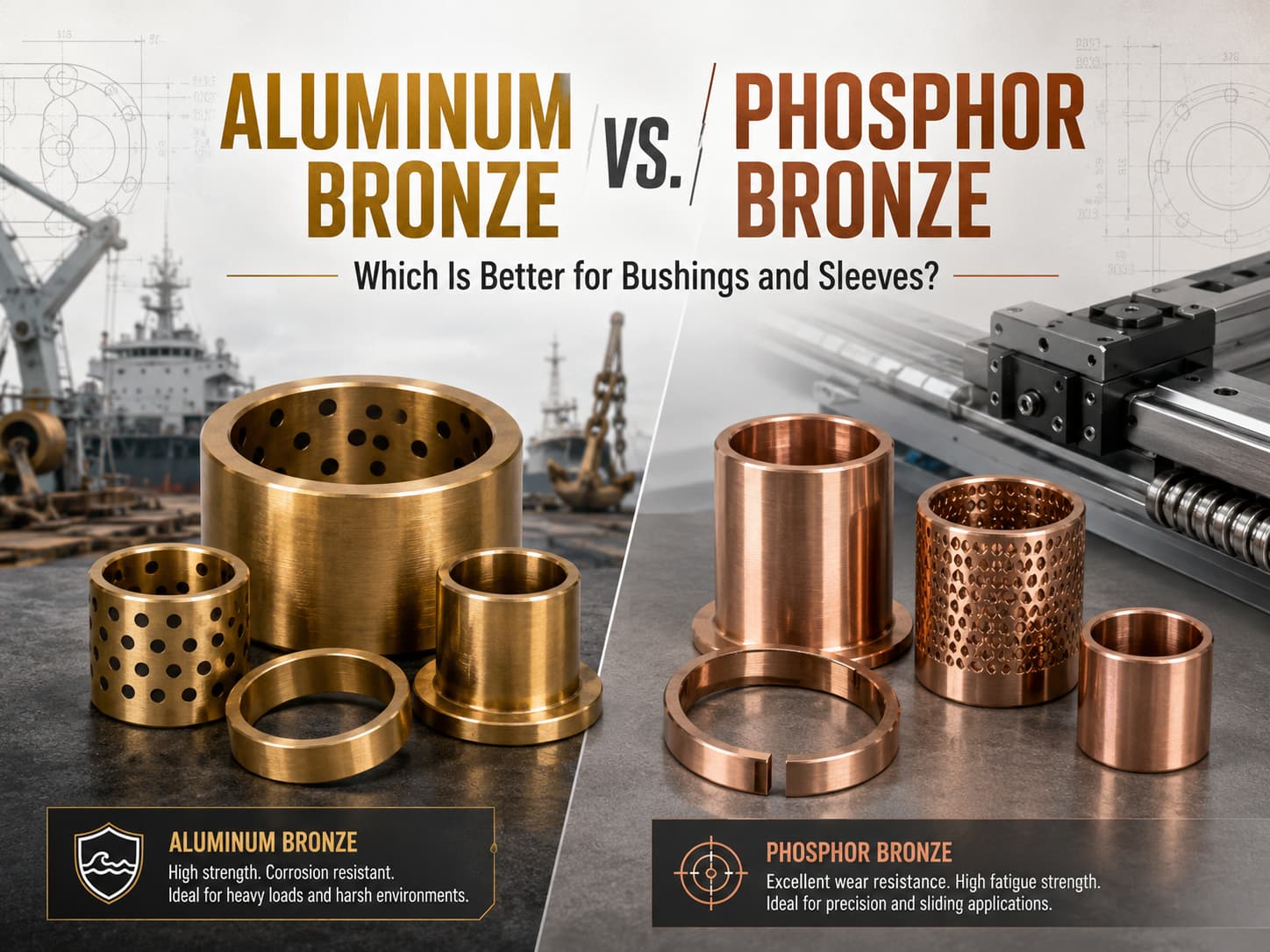
For B2B buyers, the question is often not simply “Which bronze is better?” The better question is: Which bronze alloy is better for this operating condition, load, environment, lubrication method, and manufacturing process?
Two common material options are aluminum bronze and phosphor bronze. Both are copper-based alloys, and both can be used for industrial parts. However, they perform differently in sliding, rotating, marine, machinery, and heavy-load applications. If you are comparing broader copper alloy options, King Shine’s Material page can also help you review different alloy choices.
At King Shine Resource Co., Ltd., material selection is evaluated together with casting process, machining requirements, tolerance expectations, and final application. For cylindrical or symmetrical components such as bushings, sleeves, rings, and liners, centrifugal casting is often considered because it can support dense structures and stable mechanical performance.
What Are Bushings and Sleeves?
Bushings and sleeves are commonly used in machinery, marine equipment, pumps, valves, and rotating assemblies. Their main function is to provide a controlled contact surface between moving or fitted parts.
A bushing or sleeve may be used to:
- Reduce friction between moving components
- Support a shaft or rotating part
- Improve wear resistance
- Protect the main housing or mating component
- Maintain alignment and dimensional stability
- Extend equipment service life
Because these parts often experience friction, load, vibration, and sometimes corrosive environments, alloy selection becomes critical.
What Is Aluminum Bronze?
Aluminum bronze is a copper alloy that contains aluminum as the main alloying element. Depending on the grade, it may also contain iron, nickel, manganese, or other elements to improve strength, corrosion resistance, and wear performance.
Aluminum bronze is often selected for demanding applications because it offers:
- High strength compared with many copper alloys
- Good wear resistance
- Strong corrosion resistance
- Good performance in marine and seawater environments
- Good resistance under heavy load
- Suitable performance for pump, valve, and machinery components
For bushings and sleeves, aluminum bronze is usually considered when the part must operate under heavier load, higher stress, or more corrosive conditions.
If you are evaluating aluminum bronze together with other bronze grades such as CAC406 / BC6, you can also read Choosing the Right Bronze Alloy: Is CAC406 (BC6) the Best Option?.
What Is Phosphor Bronze?
Phosphor bronze is a copper-tin alloy with a small amount of phosphorus. The phosphorus helps improve wear resistance, fatigue resistance, stiffness, and casting or processing behavior depending on the grade.
Phosphor bronze is often valued for:
- Good wear resistance
- Good fatigue performance
- Stable sliding behavior
- Moderate corrosion resistance
- Better machinability compared with some high-strength bronzes
- Good dimensional stability for precision components
For bushings and sleeves, phosphor bronze is often considered when the application requires reliable sliding performance, moderate load capacity, and good machinability.
Aluminum Bronze vs. Phosphor Bronze: Key Differences
| Comparison Item | Aluminum Bronze | Phosphor Bronze |
|---|---|---|
| Strength | Generally higher | Moderate to good |
| Wear Resistance | Very good, especially under heavier load | Very good for sliding and moderate-load use |
| Corrosion Resistance | Excellent, especially in marine environments | Good, but usually not as strong as aluminum bronze in seawater |
| Machinability | More difficult to machine | Generally easier to machine |
| Load Capacity | Better for heavy-duty applications | Better for moderate-load and precision sliding applications |
| Cost | Often higher | Often more cost-effective depending on grade |
| Best-Fit Use | Heavy-duty bushings, marine sleeves, pump/valve parts | General bushings, precision sleeves, sliding components |
For a broader comparison of brass, bronze, stainless steel, and aluminum in casting applications, see Material Selection for Centrifugal Casting: Brass, Bronze, Stainless, and Aluminum.
When Aluminum Bronze Is the Better Choice
Aluminum bronze is usually the stronger option when the bushing or sleeve must survive harsh operating conditions.
Choose aluminum bronze when:
- The part is exposed to seawater, salt spray, or marine environments
- The bushing or sleeve carries heavy load
- Higher strength is required
- Wear resistance is critical under pressure
- The part is used in pumps, valves, marine machinery, or heavy equipment
- Long service life is more important than the lowest material cost
For example, a sleeve used in marine machinery may face both mechanical wear and corrosion. In this case, aluminum bronze is often a better choice because it provides stronger corrosion resistance and mechanical strength than many standard bronze options.
However, aluminum bronze is not always the easiest material to machine. Buyers should consider machining time, tooling requirements, and final tolerance needs when specifying it.
When Phosphor Bronze Is the Better Choice
Phosphor bronze can be a better choice when the application needs good wear resistance, stable sliding behavior, and practical machinability, but does not require the higher strength or marine corrosion resistance of aluminum bronze.
Choose phosphor bronze when:
- The part is used in general machinery
- The load is moderate rather than extreme
- Sliding or rotational movement is the main concern
- Good fatigue resistance is needed
- Machining efficiency matters
- The operating environment is not severely corrosive
- Cost control is important
For example, a machinery bushing used in a controlled indoor environment may not need the corrosion resistance of aluminum bronze. In that case, phosphor bronze may provide a better balance of performance, machinability, and cost.
How Operating Environment Affects the Choice
The operating environment is one of the most important factors in bronze alloy selection.
Marine or Seawater Exposure
If the part will be used in marine hardware, seawater pumps, ship equipment, or outdoor salty environments, aluminum bronze is often the stronger candidate. Its corrosion resistance makes it suitable for more demanding environments.
General Machinery Environment
If the part will be used in standard machinery, factory equipment, or indoor mechanical assemblies, phosphor bronze may be enough. It can provide good sliding performance without over-specifying the material.
High-Friction or Poor Lubrication Conditions
Both materials can be used for wear-related applications, but the right choice depends on load, speed, lubrication, and mating material. Aluminum bronze may perform better under heavier load, while phosphor bronze can be suitable for stable sliding under moderate conditions.
How Load and Wear Conditions Affect the Choice
For bushings and sleeves, the contact condition matters as much as the material name.
You should evaluate:
- Is the load static or dynamic?
- Is the movement continuous or intermittent?
- Is lubrication available?
- Is the shaft hard or soft?
- Is the part exposed to impact or vibration?
- Is the bushing replaceable, or is failure costly?
If the bushing or sleeve is used under heavy load, shock, or demanding wear conditions, aluminum bronze is often more suitable. If the application is a precision sliding part under moderate load, phosphor bronze may be a practical and efficient choice.
How Machining Requirements Affect Material Selection
Most cast bushings and sleeves require machining after casting. Common machining steps may include:
- ID boring
- OD turning
- End-face machining
- Groove machining
- Chamfering
- Surface finish control
- Concentricity inspection
This is where material choice directly affects cost.
Aluminum bronze is strong and durable, but it can be more difficult to machine. It may require more rigid setups, proper tooling, and controlled machining parameters.
Phosphor bronze is generally more machining-friendly, which can help reduce machining time and improve cost efficiency for suitable applications.
For B2B buyers, the key is to decide whether the performance advantage of aluminum bronze is worth the additional machining complexity. If the application does not need that extra strength or corrosion resistance, phosphor bronze may be the more practical choice.
Why Casting Method Matters for Bushings and Sleeves
For cylindrical parts such as bushings and sleeves, centrifugal casting is often an important manufacturing option. The process uses rotation to distribute molten metal against the mold wall, helping create a denser structure in the working wall.
This can be useful for bushings and sleeves because the final part often depends on:
- Wall density
- Wear resistance
- Dimensional stability
- Machining allowance
- Concentricity
- Inner and outer diameter control
Whether the material is aluminum bronze or phosphor bronze, the casting process must be planned together with machining and inspection. A good material choice can still fail if the casting method, machining allowance, or inspection plan is not suitable.
For buyers evaluating larger cylindrical copper alloy parts, King Shine’s Centrifugal Casting Copper Alloy Dimensions page provides useful reference information for project discussion.
Application-Based Selection Guide
| Application Condition | Better Option | Why |
|---|---|---|
| Marine sleeve exposed to seawater | Aluminum Bronze | Strong corrosion resistance and high strength |
| Heavy-duty machinery bushing | Aluminum Bronze | Better load and wear performance |
| General industrial sleeve | Phosphor Bronze | Good balance of wear resistance, machinability, and cost |
| Precision sliding bushing under moderate load | Phosphor Bronze | Stable sliding behavior and easier machining |
| Pump or valve component in harsh environment | Aluminum Bronze | Better corrosion and mechanical performance |
| Cost-sensitive machinery component | Phosphor Bronze | Often more practical when severe corrosion is not a concern |
Questions to Ask Before Choosing the Alloy
Before deciding between aluminum bronze and phosphor bronze, buyers should ask:
- What environment will the part operate in?
Marine, freshwater, oil, indoor machinery, chemical exposure, or outdoor conditions? - What load and speed will the bushing or sleeve experience?
Heavy load, impact, rotation, sliding, or intermittent movement? - Is lubrication available?
Lubricated and dry-running conditions may require different material strategies. - Which surfaces require machining?
ID, OD, end faces, grooves, and sealing surfaces should be defined early. - What tolerance and surface finish are required?
Tight tolerances increase machining and inspection requirements. - Is corrosion resistance more important than machinability?
If yes, aluminum bronze may be worth the extra machining effort. - Is the goal maximum performance or cost-effective reliability?
The best alloy is not always the strongest one; it is the one that fits the application.
For a broader supplier-evaluation checklist, you may also refer to 7 Questions to Ask Before Choosing a Copper Alloy Casting Supplier.
Common Mistake: Choosing the Strongest Alloy by Default
Many buyers assume that the stronger material is automatically the better material. This is not always true.
Aluminum bronze may provide higher strength and corrosion resistance, but if the part is used in a moderate-load indoor machine, that extra performance may not create real value. It may only increase material and machining cost.
On the other hand, choosing phosphor bronze only because it is easier to machine may create problems if the part is exposed to seawater, heavy load, or severe wear.
The best approach is to match the alloy to the actual working condition—not just the material specification.
How King Shine Resource Co., Ltd. Can Help
At King Shine Resource Co., Ltd., we help customers evaluate bronze alloy choices based on the part’s function, environment, casting process, machining plan, and inspection requirements.
For bushings, sleeves, rings, liners, marine parts, valve components, and machinery hardware, we can support:
- Material comparison between aluminum bronze, phosphor bronze, CAC406 / BC6, lead bronze, nickel copper, and other copper alloys
- Casting process evaluation, including centrifugal casting, sand casting, investment casting, and furan casting
- Machining allowance and tolerance planning
- As-cast vs. machined feature review
- Dimensional and visual inspection planning
- RFQ review based on drawings or samples
This helps B2B buyers avoid over-specifying materials, reduce unnecessary machining cost, and select a production route that fits both performance and budget.
Conclusion
Both aluminum bronze and phosphor bronze can be good choices for bushings and sleeves, but they serve different priorities.
Aluminum bronze is often better for heavy-duty, marine, corrosive, or high-strength applications. It is a strong choice when durability and corrosion resistance are more important than machining ease.
Phosphor bronze is often better for general machinery, precision sliding components, moderate-load bushings, and applications where machinability and cost balance matter.
The best alloy depends on the part’s load, environment, lubrication, machining requirements, and final tolerance expectations. If you are unsure which bronze alloy is right for your project, King Shine Resource Co., Ltd. can review your drawings or samples and recommend a suitable material and casting process for your application.
Need Help Choosing the Right Bronze Alloy?
Share your drawings, samples, or application requirements with King Shine Resource Co., Ltd.. Our team can help evaluate the right copper alloy, casting process, machining scope, and inspection plan for your project.
Contact us to discuss your bronze casting requirements.