Introduction
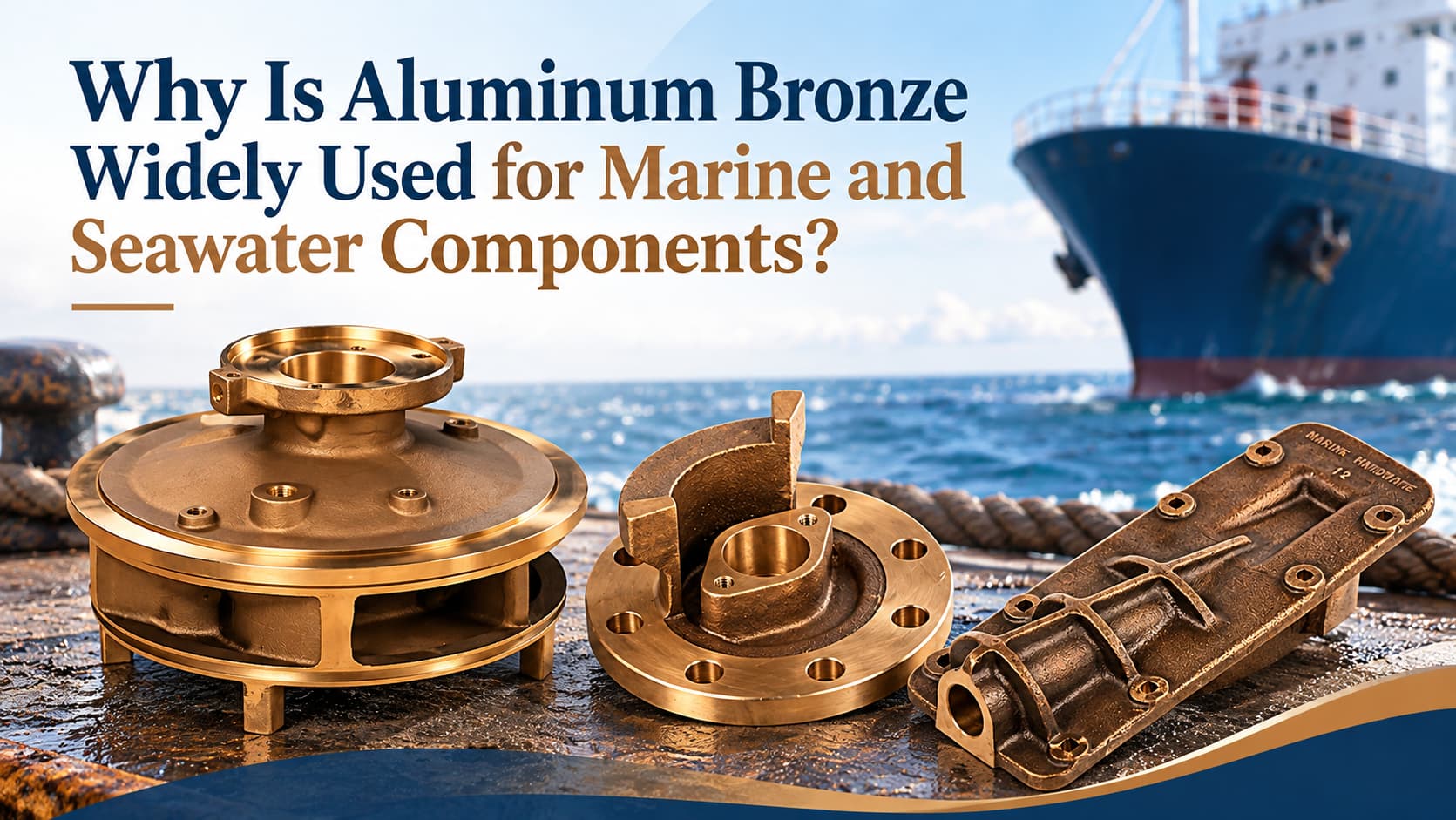
Aluminum bronze is widely used for marine and seawater components because it offers a combination of high strength, corrosion resistance, and wear performance. These properties make it a suitable material for ship propellers, marine pumps, valve components, bushings, and other metal parts exposed to demanding marine environments.
However, not all aluminum bronze grades provide the same performance. Seawater exposure, operating temperature, mechanical load, water flow, and casting quality can all affect how a component performs over time. For manufacturers and B2B buyers, selecting the right alloy grade and production process is just as important as choosing aluminum bronze itself.
At King Shine Resource Co., Ltd., we support customers sourcing customized metal components for marine, valve, and machinery applications. Through material selection and manufacturing process evaluation, we help customers identify suitable copper alloys and casting methods based on their application and drawing requirements.
This article explains why aluminum bronze is commonly selected for marine applications, where it performs best, and what buyers should consider before placing an order.
1. What Is Aluminum Bronze, and Why Is It Suitable for Marine Applications?
Aluminum bronze is a family of copper alloys containing aluminum as a principal alloying element. Depending on the grade, additional elements such as nickel, iron, and manganese may be included to improve mechanical properties and corrosion performance.
Unlike conventional brass, which primarily contains copper and zinc, aluminum bronze develops a protective surface oxide film that contributes to its corrosion resistance.
This characteristic, combined with its mechanical strength, makes certain aluminum bronze grades particularly suitable for components operating in seawater.
Key Properties of Aluminum Bronze
- Seawater corrosion resistance: The protective oxide film helps limit corrosion under suitable operating conditions.
- High mechanical strength: Many aluminum bronze grades provide higher strength than conventional tin bronzes.
- Wear resistance: Suitable grades can withstand demanding sliding and mechanical contact conditions.
- Erosion resistance: Selected aluminum bronze alloys offer good resistance to flowing seawater and erosion-related damage.
- Cavitation resistance: Certain nickel aluminum bronze grades are used in components exposed to cavitation, including marine propellers.
These characteristics help explain why aluminum bronze has long been used in marine engineering. However, the exact alloy grade, microstructure, and operating conditions must be considered before selecting a material.
2. Why Does Aluminum Bronze Resist Seawater Corrosion?
Seawater contains dissolved salts, including chlorides, that can accelerate corrosion in many metals. Marine components may also experience continuous immersion, intermittent wetting, salt spray, and changing water flow.
One of aluminum bronze's important advantages is its ability to develop a relatively stable protective oxide film.
How the Protective Film Works
When aluminum bronze is exposed to suitable environmental conditions, an aluminum-rich oxide layer develops on its surface. This layer helps reduce direct contact between the underlying metal and the surrounding environment.
The protective film can also reform after minor surface damage under favorable conditions.
However, aluminum bronze is not completely immune to corrosion.
Specific service conditions, including stagnant seawater, polluted water, unfavorable microstructures, and crevices, may increase the risk of localized corrosion or selective phase attack.
Key Takeaway: Aluminum bronze offers valuable seawater corrosion resistance, but material grade, casting quality, and actual service conditions must be evaluated together.
For this reason, engineers should evaluate the actual environment rather than assuming every aluminum bronze grade is equally suitable for seawater service.
3. Which Marine Components Commonly Use Aluminum Bronze?
Aluminum bronze is used in various marine applications where corrosion resistance and mechanical performance are both important.
Marine Propellers
Marine propellers are exposed to seawater, rotational forces, cyclic loading, and cavitation.
Nickel aluminum bronze is an established material choice for many marine propellers because of its combination of strength, corrosion resistance, and cavitation-erosion performance.
Seawater Pumps and Impellers
Pumps used in marine cooling and seawater circulation systems must withstand corrosion and mechanical forces.
Suitable aluminum bronze alloys may be selected for pump casings, impellers, and related components.
Marine Valve Components
Valve bodies and associated components used in seawater systems require material compatibility with the fluid, pressure, and operating temperature.
Aluminum bronze can be considered where corrosion resistance and mechanical strength are required.
Bushings and Sleeves
Bushings and sleeves used in marine machinery may experience sliding contact, vibration, and moisture exposure.
Certain aluminum bronze grades provide a useful combination of strength and corrosion resistance when properly matched with the shaft material and lubrication conditions.
For buyers sourcing cast parts, King Shine provides Marine Hardware and Valve Components product categories that demonstrate the company's application focus.
4. What Are the Advantages of Aluminum Bronze Over Other Copper Alloys in Marine Applications?
Different copper alloys offer different combinations of corrosion resistance, strength, machinability, and cost.
Aluminum bronze is not necessarily the best choice for every marine component, but its combination of properties makes it an important option in demanding applications.
| Material | Key Characteristics | Typical Selection Considerations |
|---|---|---|
| Aluminum Bronze | High strength, good corrosion resistance, and wear performance | Marine pumps, valves, propellers, and heavy-duty components |
| Phosphor Bronze | Good wear resistance and fatigue properties | Bushings, sleeves, and sliding components |
| Brass | Good castability and machinability; performance varies by grade | Fittings and components where a suitable marine-grade brass meets requirements |
| Copper-Nickel | Strong seawater corrosion resistance in suitable systems | Seawater piping and heat-exchanger applications |
The table provides general comparisons; actual performance depends on alloy grade, operating environment, and component design.
For example, aluminum bronze may be preferred when strength and seawater resistance are both important. However, another copper alloy may be more appropriate when the application prioritizes machinability, thermal performance, or a different combination of properties.
For a more detailed comparison focused on wear-related components, read our previous article: Aluminum Bronze vs. Phosphor Bronze: Which Is Better for Bushings and Sleeves?
5. Does Every Aluminum Bronze Grade Perform the Same in Seawater?
No. Aluminum bronze is an alloy family rather than a single material specification.
Different aluminum bronze grades contain different amounts of aluminum, nickel, iron, and other alloying elements. These differences affect mechanical strength, corrosion performance, casting behavior, and machinability.
For example, nickel aluminum bronze is widely used in demanding marine applications because selected grades offer favorable combinations of mechanical and corrosion properties.
However, even within this alloy family, heat treatment, casting microstructure, and service conditions can influence resistance to selective phase corrosion and other forms of degradation.
What Should Buyers Confirm?
- The applicable material standard and alloy designation
- Whether the component operates in continuously flowing or stagnant seawater
- Expected operating temperature and pressure
- Mechanical loads and wear conditions
- The need for welding, heat treatment, or machining
- Required material and inspection documentation
Selecting aluminum bronze solely by its general material name may lead to unsuitable performance expectations.
For additional guidance on bronze material selection, see Choosing the Right Bronze Alloy: Is CAC406 (BC6) the Best Option?
6. How Does the Casting Process Affect Aluminum Bronze Marine Components?
Choosing an appropriate alloy is only part of the manufacturing decision.
The casting method must also match the component's size, geometry, quantity, surface requirements, and machining needs.
Several metal casting processes may be evaluated for copper alloy marine components.
Sand Casting
Sand casting is suitable for a wide variety of component sizes and shapes.
It may be considered for marine pump housings, valve bodies, and other structural parts where complex geometry or larger dimensions make sand molds practical.
Machining may be required on sealing faces, mounting surfaces, or precision interfaces.
Lost Wax Casting
Lost wax casting, also known as investment casting, is often considered for smaller components with complex geometries and detailed features.
It can reduce the amount of finishing required on certain surfaces, although critical dimensions may still require machining.
The selected copper alloy must also be compatible with the investment casting process.
Centrifugal Casting
Centrifugal casting is particularly suitable for hollow, cylindrical, and rotationally symmetrical components.
The process uses centrifugal force to distribute molten metal against the mold wall. Under properly controlled conditions, it can help produce sound cast walls and reduce certain porosity-related concerns.
For marine-related bushings, sleeves, rings, or liners, centrifugal casting may offer manufacturing advantages when component geometry and alloy characteristics are suitable.
Buyers evaluating cylindrical copper alloy parts can also review King Shine's Centrifugal Casting Dimensions information.
Furan Resin Sand Casting
Furan resin sand casting uses resin-bonded sand molds. It may be considered for components requiring relatively strong, dimensionally stable molds, depending on casting size and geometry.
King Shine also presents Furan Casting for Marine Hardware among its product applications.
Key Takeaway: The most suitable casting process is not determined by material alone. Component geometry, production quantity, dimensional requirements, manufacturing capability, and total cost must be assessed together.
7. What Should B2B Buyers Check Before Ordering Aluminum Bronze Marine Components?
Even when aluminum bronze is suitable for the application, buyers should confirm several manufacturing requirements before placing an order.
Material Specification
Specify the exact alloy grade and relevant material standard whenever available.
Operating Environment
Clarify whether the component will encounter seawater immersion, salt spray, seawater flow, or another marine-related environment.
Machining and Tolerances
Identify which surfaces require precision machining and which can remain as-cast. This is particularly important for valve seats, bores, mounting faces, and shaft interfaces.
Inspection Requirements
Define the required dimensional inspection, material verification, and application-specific testing before production. Pressure or leak testing should be specified where applicable rather than assumed to be included.
Drawings and Order Information
Provide 2D drawings, 3D models, quantities, surface requirements, and expected delivery conditions to support an accurate manufacturing evaluation.
For a broader purchasing checklist, read 7 Questions to Ask Before Choosing a Copper Alloy Casting Supplier .
8. How King Shine Resource Co., Ltd. Supports Marine Copper Alloy Casting Projects
Selecting an aluminum bronze alloy for marine components requires consideration of material properties, service environment, casting feasibility, and downstream machining.
King Shine Resource Co., Ltd. supports customized metal part sourcing across marine hardware, valve components, and machinery hardware applications.
Our value is not limited to a single casting method. Through multiple manufacturing process options, including sand casting, lost wax casting, centrifugal casting, and furan casting, we can help customers evaluate suitable production routes according to their component requirements.
For Copper Alloy Marine Projects, Customers Can Discuss:
- Copper alloy and casting process selection
- Component size and geometry
- As-cast and machined surface requirements
- Machining allowances and dimensional tolerances
- Inspection and quality expectations
- Drawing-based or sample-based quotation requirements
By considering these factors early, buyers can make better-informed sourcing decisions and reduce avoidable production uncertainties.
Conclusion: Is Aluminum Bronze the Right Choice for Your Marine Components?
Aluminum bronze is widely used in marine engineering because selected grades combine seawater corrosion resistance with high mechanical strength and useful wear performance.
These advantages make it an important material option for marine pumps, valves, propellers, bushings, sleeves, and related components.
However, the most suitable material depends on the actual service environment, alloy grade, casting process, machining requirements, and inspection standards.
For manufacturers and B2B buyers, the goal should not be to choose aluminum bronze simply because it is widely used in marine applications. The goal is to select the appropriate alloy and manufacturing method for the component's intended function.
Looking for a Copper Alloy Casting Supplier for Marine Components?
If you are developing or sourcing marine hardware, valve components, or custom copper alloy castings, King Shine Resource Co., Ltd. can help evaluate your drawings, material requirements, and suitable manufacturing options.
Contact our team to discuss your project, evaluate suitable materials and manufacturing processes, and request a quotation.
Contact King ShineTechnical References
The technical discussion of aluminum bronze seawater performance draws on published engineering references, including the Copper Development Association's guide to nickel aluminium bronze.